
6.3 Graphs of Logarithmic Functions do todo’s
Learning Objectives
After completing this section, you should be able to…
- Identify the domain of a logarithmic function.
- Graph logarithmic functions.
In Graphs of Exponential Functions, we saw how creating a graphical representation of an exponential model gives us another layer of insight for predicting future events. How do logarithmic graphs give us insight into situations? Because every logarithmic function is the inverse function of an exponential function, we can think of every output on a logarithmic graph as the input for the corresponding inverse exponential equation. In other words, logarithms give the cause for an effect.
To illustrate, suppose we invest  in an account that offers an annual interest rate of
  compounded continuously. We already know that the balance in our account for any year
  can be found with the equation
But what if we wanted to know the year for any balance? We would need to create a corresponding new function by interchanging the input and the output; thus we would need to create a logarithmic model for this situation. By graphing the model, we can see the output (year) for any input (account balance). For instance, what if we wanted to know how many years it would take for our initial investment to double? Figure 1 shows this point on the logarithmic graph.
In this section we will discuss the values for which a logarithmic function is defined, and then turn our attention to graphing the family of logarithmic functions.
Finding the Domain of a Logarithmic Function
Before working with graphs, we will take a look at the domain (the set of input values) for which the logarithmic function is defined.
Recall that the exponential function is defined as  for any real number
  and constant
 where
where
- The domain of
 is
is 
- The range of is

In the last section we learned that the logarithmic function  is the inverse of the exponential function
  So, as inverse functions:
- The domain of is the range of

- The range of is the domain of
Transformations of the parent function behave similarly to those of other functions. Just as with other parent functions, we can apply the four types of transformations—shifts, stretches, compressions, and reflections.
In Graphs of Exponential Functions we saw that certain transformations can change the range of Similarly, applying transformations to the parent function can change the domain. When finding the domain of a logarithmic function, therefore, it is important to remember that the domain consists only of positive real numbers. That is, the argument of the logarithmic function must be greater than zero.
For example, consider  This function is defined for any values of such that the argument, in this case
  is greater than zero. To find the domain, we set up an inequality and solve for
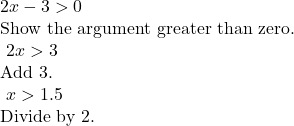
In interval notation, the domain of  is
is 
How To
Given a logarithmic function, identify the domain.
- Set up an inequality showing the argument greater than zero.
- Solve for

- Write the domain in interval notation.
Example 1
Identifying the Domain of a Logarithmic Shift
What is the domain of 
Solution
 Solving this inequality,
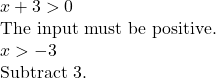 The domain of
  is
is 
Try It 1
What is the domain of 
Show Solution

Example 2
Identifying the Domain of a Logarithmic Shift and Reflection
What is the domain of 
Solution #TODO: fix the formating on the latex for the solution
 Solving this inequality,
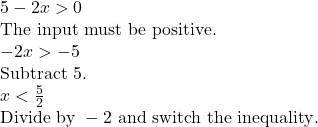 The domain of
  is
is 
Try It 2
What is the domain of 
Show Solution

Graphing Logarithmic Functions
Now that we have a feel for the set of values for which a logarithmic function is defined, we move on to graphing logarithmic functions. The family of logarithmic functions includes the parent function along with all its transformations: shifts, stretches, compressions, and reflections.
We begin with the parent function  Because every logarithmic function of this form is the inverse of an exponential function with the form
  their graphs will be reflections of each other across the line
  To illustrate this, we can observe the relationship between the input and output values of
  and its equivalent
  in Table 1.
| |
 |
 |
 |
 |
 |
 |
 |
 |
 |
 |
 |
|
|
 |
 |
 |
|
|
|
|
|
|
|
Table 1
Using the inputs and outputs from Table 1, we can build another table to observe the relationship between points on the graphs of the inverse functions  and
and  See Table 2.
| |
 |
 |
 |
 |
 |
 |
 |
 |
 |
 |
 |
 |
 |
 |
 |
Table 2
As we’d expect, the x– and y-coordinates are reversed for the inverse functions. Figure 2 shows the graph of  and
and 
 and
and  are reflections about the line
 Observe the following from the graph:
- has a y-intercept at and has an x– intercept at

- The domain of

 is the same as the range of
 - The range of
 is the same as the domain of
Characteristics of the Graph of the Parent Function, 
For any real number and constant we can see the following characteristics in the graph of
-
one-to-one function
-
vertical asymptote:

-
domain:

-
range:

-
x-intercept:
and key point 
-
y-intercept: none
-
increasing if

-
decreasing if

See Figure 3.
<img src=”https://openstax.org/apps/archive/20250916.165151/resources/03bc36fb3910fdc64301f537e6573561e438622f” alt=”The first graph shows the line of f(x) = logb(x) when b>1, and the second graph shows the line when 0<bFigure 3
Figure 4 shows how changing the base  in
in  can affect the graphs. Observe that the graphs compress vertically as the value of the base increases. (Note: recall that the function
  has base
How To
Given a logarithmic function with the form  graph the function.
- Draw and label the vertical asymptote,

- Plot the x-intercept,
- Plot the key point

- Draw a smooth curve through the points.
- State the domain, the range, and the vertical asymptote,
Example 3
Graphing a Logarithmic Function with the Form f(x) = logb(x).
Graph  State the domain, range, and asymptote.
Solution
- Since
 is greater than one, we know the function is increasing. The left tail of the graph will approach the vertical asymptote
  and the right tail will increase slowly without bound.
 - The x-intercept is
- The key point
 is on the graph.
 - We draw and label the asymptote, plot and label the points, and draw a smooth curve through the points (see Figure 5).
The domain is the range is and the vertical asymptote is
Try It 3
Graph  State the domain, range, and asymptote.
Show Solution
The domain is  , the range is
  , and the vertical asymptote is .
Graphing Transformations of Logarithmic Functions
As we mentioned in the beginning of the section, transformations of logarithmic graphs behave similarly to those of other parent functions. We can shift, stretch, compress, and reflect the parent function without loss of shape.
Graphing a Horizontal Shift of f(x) = logb(x)
When a constant  is added to the input of the parent function
  the result is a horizontal shift units in the opposite direction of the sign on
  To visualize horizontal shifts, we can observe the general graph of the parent function and for
  alongside the shift left,
  and the shift right,
  See Figure 6.
Horizontal Shifts of the Parent Function
For any constant  the function
- shifts the parent function left units if

- shifts the parent function right units if

- has the vertical asymptote

- has domain

- has range
How To
Given a logarithmic function with the form  graph the translation.
- Identify the horizontal shift:
- If
 shift the graph of left units.
 - If
 shift the graph of right units.
- If
- Draw the vertical asymptote
- Identify three key points from the parent function. Find new coordinates for the shifted functions by subtracting from the coordinate.
- Label the three points.
- The Domain is
 the range is and the vertical asymptote is
Example 4
Graphing a Horizontal Shift of the Parent Function y = logb(x)
Sketch the horizontal shift  alongside its parent function. Include the key points and asymptotes on the graph. State the domain, range, and asymptote.
Solution
 we notice
  Thus
Thus  so This means we will shift the function
  right 2 units.The vertical asymptote is
  or
or  Consider the three key points from the parent function,
 and
and  The new coordinates are found by adding 2 to the coordinates.Label the points
 and
and  The domain is
  the range is and the vertical asymptote is
Try It 4
Sketch a graph of  alongside its parent function. Include the key points and asymptotes on the graph. State the domain, range, and asymptote.
Show Solution
The domain is  , the range , and the asymptote
  .
.
Graphing a Vertical Shift of y = logb(x)
When a constant  is added to the parent function the result is a vertical shift units in the direction of the sign on
  To visualize vertical shifts, we can observe the general graph of the parent function alongside the shift up,
  and the shift down,
  See Figure 8.
Vertical Shifts of the Parent Function
For any constant  the function
- shifts the parent function up units if

- shifts the parent function down units if

- has the vertical asymptote
- has domain
- has range
How To
Given a logarithmic function with the form  graph the translation.
- Identify the vertical shift:
- If
 shift the graph of up units.
 - If
 shift the graph of down units.
- If
- Draw the vertical asymptote
- Identify three key points from the parent function. Find new coordinates for the shifted functions by adding to the coordinate.
- Label the three points.
- The domain is the range is and the vertical asymptote is
Example 5
Graphing a Vertical Shift of the Parent Function y = logb(x)
Sketch a graph of  alongside its parent function. Include the key points and asymptote on the graph. State the domain, range, and asymptote.
Solution
 we will notice
  Thus This means we will shift the function down 2 units.The vertical asymptote is Consider the three key points from the parent function, and The new coordinates are found by subtracting 2 from the y coordinates.Label the points
 and
and  The domain is the range is and the vertical asymptote is
The domain is the range is and the vertical asymptote is
Try It 5
Sketch a graph of  alongside its parent function. Include the key points and asymptote on the graph. State the domain, range, and asymptote.
Show Solution
The domain is , the range is , and the vertical asymptote is .
Graphing Stretches and Compressions of y = logb(x)
When the parent function is multiplied by a constant  the result is a vertical stretch or compression of the original graph. To visualize stretches and compressions, we set
  and observe the general graph of the parent function alongside the vertical stretch,
  and the vertical compression,
  See Figure 10.
Vertical Stretches and Compressions of the Parent Function
For any constant  the function
- stretches the parent function vertically by a factor of
 if
if 
- compresses the parent function vertically by a factor of if

- has the vertical asymptote
- has the x-intercept
- has domain
- has range
How To
Given a logarithmic function with the form  graph the translation.
- Identify the vertical stretch or compressions:
- If
 the graph of is stretched by a factor of units.
 - If
 the graph of is compressed by a factor of units.
- If
- Draw the vertical asymptote
- Identify three key points from the parent function. Find new coordinates for the shifted functions by multiplying the coordinates by

- Label the three points.
- The domain is the range is and the vertical asymptote is
Example 6
Graphing a Stretch or Compression of the Parent Function y = logb(x)
Sketch a graph of  alongside its parent function. Include the key points and asymptote on the graph. State the domain, range, and asymptote.
Solution
 we will notice
  This means we will stretch the function
  by a factor of 2.The vertical asymptote is Consider the three key points from the parent function,
  and
and  The new coordinates are found by multiplying the coordinates by 2.Label the points
 and
and  The domain is
  the range is and the vertical asymptote is See Figure 11.
The domain is the range is and the vertical asymptote is
Try It 6
Sketch a graph of  alongside its parent function. Include the key points and asymptote on the graph. State the domain, range, and asymptote.
Show Solution
The domain is , the range is , and the vertical asymptote is .
Example 7
Combining a Shift and a Stretch
Sketch a graph of  State the domain, range, and asymptote.
Solution
 The x-intercept will be
  The domain will be
  Two points will help give the shape of the graph:
  and
and  We chose
  as the x-coordinate of one point to graph because when
 the base of the common logarithm.
The domain is  the range is and the vertical asymptote is
Try It 7
Sketch a graph of the function  State the domain, range, and asymptote.
Show Solution
The domain is , the range is , and the vertical asymptote is  .
.
Graphing Reflections of f(x) = logb(x)
When the parent function is multiplied by  the result is a reflection about the x-axis. When the input is multiplied by the result is a reflection about the y-axis. To visualize reflections, we restrict
  and observe the general graph of the parent function alongside the reflection about the x-axis,
  and the reflection about the y-axis,
Reflections of the Parent Function
The function 
- reflects the parent function about the x-axis.
- has domain, range, and vertical asymptote, which are unchanged from the parent function.
The function 
- reflects the parent function about the y-axis.
- has domain

- has range, and vertical asymptote, which are unchanged from the parent function.
How To
Given a logarithmic function with the parent function graph a translation.
If  |
If  |
|---|---|
| 1. Draw the vertical asymptote, |
1. Draw the vertical asymptote, |
| 2. Plot the x-intercept, |
2. Plot the x-intercept, |
| 3. Reflect the graph of the parent function about the x-axis. |
3. Reflect the graph of the parent function about the y-axis. |
| 4. Draw a smooth curve through the points. | 4. Draw a smooth curve through the points. |
| 5. State the domain, (0, ∞), the range, (−∞, ∞), and the vertical asymptote . |
5. State the domain, (−∞, 0) the range, (−∞, ∞) and the vertical asymptote |
Table 3
Example 8
Graphing a Reflection of a Logarithmic Function
Sketch a graph of  alongside its parent function. Include the key points and asymptote on the graph. State the domain, range, and asymptote.
Solution
 identify the behavior and key points for the graph.
- Since
 is greater than one, we know that the parent function is increasing. Since the input value is multiplied by is a reflection of the parent graph about the y-axis. Thus, will be decreasing as moves from negative infinity to zero, and the right tail of the graph will approach the vertical asymptote
 - The x-intercept is
- We draw and label the asymptote, plot and label the points, and draw a smooth curve through the points.
The domain is  the range is and the vertical asymptote is
Try It 8
Graph  State the domain, range, and asymptote.
Show Solution
The domain is  , the range is , and the vertical asymptote is .
How To
Given a logarithmic equation, use a graphing calculator to approximate solutions.
- Press [Y=]. Enter the given logarithm equation or equations as Y1= and, if needed, Y2=.
- Press [GRAPH] to observe the graphs of the curves and use [WINDOW] to find an appropriate view of the graphs, including their point(s) of intersection.
- To find the value of
 we compute the point of intersection. Press [2ND] then [CALC]. Select “intersect” and press [ENTER] three times. The point of intersection gives the value of for the point(s) of intersection.
Example 9
Approximating the Solution of a Logarithmic Equation
Solve  graphically. Round to the nearest thousandth.
Solution
 next to Y1=. Then enter
  next to Y2=. For a window, use the values 0 to 5 for and –10 to 10 for
  Press [GRAPH]. The graphs should intersect somewhere a little to right of
  For a better approximation, press [2ND] then [CALC]. Select [5: intersect] and press [ENTER] three times. The x-coordinate of the point of intersection is displayed as 1.3385297. (Your answer may be different if you use a different window or use a different value for Guess?) So, to the nearest thousandth,
Try It 9
Solve  graphically. Round to the nearest thousandth.
Show Solution

Summarizing Translations of the Logarithmic Function
Now that we have worked with each type of translation for the logarithmic function, we can summarize each in Table 4 to arrive at the general equation for translating exponential functions.
| Transformations of the Parent Function |
|
|---|---|
| Transformation | Form |
Shift
|
 |
Stretch and Compress
|
 |
| Reflect about the x-axis |  |
| Reflect about the y-axis |  |
| General equation for all translations |  |


Table 4
Transformations of Logarithmic Functions
All transformations of the parent logarithmic function,  have the form

where the parent function,  is
is
- shifted vertically up units.
- shifted horizontally to the left units.
- stretched vertically by a factor of
 if
if 
- compressed vertically by a factor of if

- reflected about the x-axis when

For  the graph of the parent function is reflected about the y-axis.
Example 10
Finding the Vertical Asymptote of a Logarithm Graph
What is the vertical asymptote of 
Solution

Analysis
The coefficient, the base, and the upward translation do not affect the asymptote. The shift of the curve 4 units to the left shifts the vertical asymptote to 
Try It 10
What is the vertical asymptote of 
Show Solution

Example 11
Finding the Equation from a Graph
Find a possible equation for the common logarithmic function graphed in Figure 15.
Solution
 and has been vertically reflected. We do not know yet the vertical shift or the vertical stretch. We know so far that the equation will have form:
 It appears the graph passes through the points
  and
and  Substituting
  [latex]\begin{array}{l}1=-a\mathrm{log}\left(−1+2\right)+k\hfill & \text{Substitute }\left(−1,1\right).\hfill \\ 1=-a\mathrm{log}\left(1\right)+k\hfill & \text{Arithmetic}.\hfill \\ 1=k\hfill & \text{log(1)}=0.\hfill \end{array}[/latex]Next, substituting in
  ,
,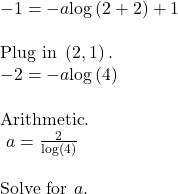 This gives us the equation
Analysis
We can verify this answer by comparing the function values in Table 5 with the points on the graph in Figure 15.
| |
−1 | 0 | 1 | 2 | 3 |
 |
1 | 0 | −0.58496 | −1 | −1.3219 |
| |
4 | 5 | 6 | 7 | 8 |
| |
−1.5850 | −1.8074 | −2 | −2.1699 | −2.3219 |
Table 5
Try It 11
Give the equation of the natural logarithm graphed in Figure 16.
Show Solution

Q&A
Is it possible to tell the domain and range and describe the end behavior of a function just by looking at the graph?
Yes, if we know the function is a general logarithmic function. For example, look at the graph in Figure 16. The graph approaches  (or thereabouts) more and more closely, so is, or is very close to, the vertical asymptote. It approaches from the right, so the domain is all points to the right,
  The range, as with all general logarithmic functions, is all real numbers. And we can see the end behavior because the graph goes down as it goes left and up as it goes right. The end behavior is that as
  and as
6.4 Exercise Set
- 1. The inverse of every logarithmic function is an exponential function and vice-versa. What does this tell us about the relationship between the coordinates of the points on the graphs of each?
- 2. What type(s) of translation(s), if any, affect the range of a logarithmic function?
- 3. What type(s) of translation(s), if any, affect the domain of a logarithmic function?
- 4. Consider the general logarithmic function
 Why can’t be zero?
 - 5. Does the graph of a general logarithmic function have a horizontal asymptote? Explain.
- 6.
- 7.

- 8.

- 9.

- 10.

- 11.

- 12.

- 13.

- 14.

- 15.

- 16.

- 17.

- 18.

- 19.

- 20.

- 21.

- 22.

- 23.

- 24.

- 25.

- 26.

- 27.

- 28.
- 29.

- 30.

- 31.
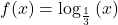
- 32.
- 33.
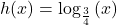
- 34.
 and
and 
- 35. and
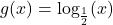
- 36.
 and
and 
- 37.
 and
and - 38.

- 39.

- 40.

- 41.

- 42.

- 43.

- 44.

- 45.

- 46.

- 47. Use
 as the parent function.
- 48. Use
 as the parent function.
- 49. Use as the parent function.
- 50. Use
 as the parent function.
- 51.

- 52.

- 53.

- 54.

- 55.

- 56. Let be any positive real number such that
 What must
  be equal to? Verify the result.
 - 57. Explore and discuss the graphs of
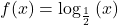 and
and  Make a conjecture based on the result.
 - 58. Prove the conjecture made in the previous exercise.
- 59. What is the domain of the function
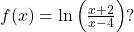 Discuss the result.
 - 60. Use properties of exponents to find the x-intercepts of the function
 algebraically. Show the steps for solving, and then verify the result by graphing the function.
Answers
- Since the functions are inverses, their graphs are mirror images about the line
 . So for every point
  on the graph of a logarithmic function, there is a corresponding point
  on the graph of its inverse exponential function.
 - Shifting the function right or left and reflecting the function about the y-axis will affect its domain.
- No. A horizontal asymptote would suggest a limit on the range, and the range of any logarithmic function in general form is all real numbers.
- Domain:
 ; Range:
 - Domain:
 ; Range:
 - Domain: ; Vertical asymptote:

- Domain:
 ; Vertical asymptote:
- Domain:
 ; Vertical asymptote:
- Domain:
 ; Vertical asymptote:
  ; End behavior: as
  ,
,  and as
- Domain: ; Vertical asymptote: ; End behavior: as
 , and as
  ,
, 
- Domain:
 ; Range: ; Vertical asymptote: ; x-intercept:
  ; y-intercept: DNE
 - Domain: ; Range: ; Vertical asymptote: ; x-intercept:
 ; y-intercept: DNE
 - Domain: ; Range: ; Vertical asymptote: ; x-intercept:
 ; y-intercept: DNE
 - B
- C
- B
- C
-
Figure 16 Graph of two functions, g(x) = log_(1/2)(x) in orange and f(x)=log(x) in blue. -
Figure 17 Graph of two functions, g(x) = ln(1/2)(x) in orange and f(x)=e^(x) in blue. - C
-
Figure 18 Graph of f(x)=log_2(x+2). -
Figure 19 Graph of f(x)=ln(-x). -
Figure 20 Graph of g(x)=log(6-3x)+1. 



- The graphs of
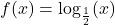 and
and  appear to be the same; Conjecture: for any positive base
  ,
,  .
. - Recall that the argument of a logarithmic function must be positive, so we determine where
 . From the graph of the function
  , note that the graph lies above the x-axis on the interval
  and again to the right of the vertical asymptote, that is
  . Therefore, the domain is
  .
.
Text Attribution
This text was adapted from Chapter 6.4 of Algebra and Trigonometry 2e, textbooks originally published by OpenStax.