
5.1 Exponents Review
Learning Objectives
After completing this section, you should be able to…
- Use the product rule of exponents.
- Use the quotient rule of exponents.
- Use the power rule of exponents.
- Use the zero exponent rule of exponents.
- Use the negative rule of exponents.
- Find the power of a product and a quotient.
- Simplify exponential expressions.
Mathematicians, scientists, and economists commonly encounter very large and very small numbers. But it may not be obvious how common such figures are in everyday life. For instance, a pixel is the smallest unit of light that can be perceived and recorded by a digital camera. A particular camera might record an image that is 2,048 pixels by 1,536 pixels, which is a very high resolution picture. It can also perceive a color depth (gradations in colors) of up to 48 bits per pixel, and can shoot the equivalent of 24 frames per second. The maximum possible number of bits of information used to film a one-hour (3,600-second) digital film is then an extremely large number.
Using a calculator, we enter  and press ENTER. The calculator displays 1.304596316E13. What does this mean? The “E13” portion of the result represents the exponent 13 of ten, so there are a maximum of approximately
  bits of data in that one-hour film. In this section, we review rules of exponents first and then apply them to calculations involving very large or small numbers.
Using the Product Rule of Exponents
Consider the product  . Both terms have the same base, x, but they are raised to different exponents. Expand each expression, and then rewrite the resulting expression.
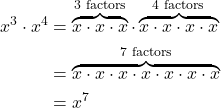
The result is that  .
.
Notice that the exponent of the product is the sum of the exponents of the terms. In other words, when multiplying exponential expressions with the same base, we write the result with the common base and add the exponents. This is the product rule of exponents.

Now consider an example with real numbers.

We can always check that this is true by simplifying each exponential expression. We find that  is 8,
is 8,  is 16, and
  is 128. The product
  equals 128, so the relationship is true. We can use the product rule of exponents to simplify expressions that are a product of two numbers or expressions with the same base but different exponents.
The Product Rule of Exponents
For any real number  and natural numbers
  and
and  the product rule of exponents states that
Example 1
Using the Product Rule
Write each of the following products with a single base. Do not simplify further.


Solution
Use the product rule to simplify each expression.


At first, it may appear that we cannot simplify a product of three factors. However, using the associative property of multiplication, begin by simplifying the first two.

Notice we get the same result by adding the three exponents in one step.

Try It 1
Write each of the following products with a single base. Do not simplify further.


Show Solution


Using the Quotient Rule of Exponents
The quotient rule of exponents allows us to simplify an expression that divides two numbers with the same base but different exponents. In a similar way to the product rule, we can simplify an expression such as  where
where  Consider the example
  Perform the division by canceling common factors.
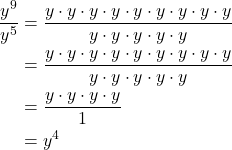
Notice that the exponent of the quotient is the difference between the exponents of the divisor and dividend.

In other words, when dividing exponential expressions with the same base, we write the result with the common base and subtract the exponents.
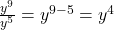
For the time being, we must be aware of the condition Otherwise, the difference  could be zero or negative. Those possibilities will be explored shortly. Also, instead of qualifying variables as nonzero each time, we will simplify matters and assume from here on that all variables represent nonzero real numbers.
The Quotient Rule of Exponents
For any real number and natural numbers and such that  the quotient rule of exponents states that
Example 2
Using the Quotient Rule
Write each of the following products with a single base. Do not simplify further.


Solution
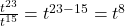
Use the quotient rule to simplify each expression.


Try It 2
Write each of the following products with a single base. Do not simplify further.


Show Solution


Using the Power Rule of Exponents
Suppose an exponential expression is raised to some power. Can we simplify the result? Yes. To do this, we use the power rule of exponents. Consider the expression  The expression inside the parentheses is multiplied twice because it has an exponent of 2. Then the result is multiplied three times because the entire expression has an exponent of 3.
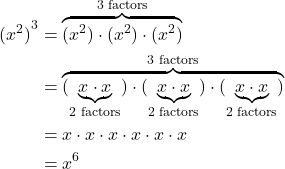
The exponent of the answer is the product of the exponents:  In other words, when raising an exponential expression to a power, we write the result with the common base and the product of the exponents.

Be careful to distinguish between uses of the product rule and the power rule. When using the product rule, different terms with the same bases are raised to exponents. In this case, you add the exponents. When using the power rule, a term in exponential notation is raised to a power. In this case, you multiply the exponents.

The Power Rule of Exponents
For any real number and positive integers and the power rule of exponents states that
Example 3
Using the Power Rule
Write each of the following products with a single base. Do not simplify further.


Solution
Use the power rule to simplify each expression.



Try It 3
Write each of the following products with a single base. Do not simplify further.


Show Solution


Using the Zero Exponent Rule of Exponents
Return to the quotient rule. We made the condition that  so that the difference would never be zero or negative. What would happen if
  In this case, we would use the zero exponent rule of exponents to simplify the expression to 1. To see how this is done, let us begin with an example.

If we were to simplify the original expression using the quotient rule, we would have
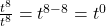
If we equate the two answers, the result is  This is true for any nonzero real number, or any variable representing a real number.

The sole exception is the expression  This appears later in more advanced courses, but for now, we will consider the value to be undefined.
The Zero Exponent Rule of Exponents
For any nonzero real number  the zero exponent rule of exponents states that
Example 4
Using the Zero Exponent Rule
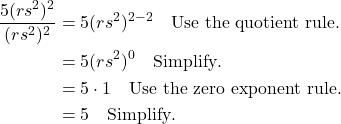
Simplify each expression using the zero exponent rule of exponents.


Solution
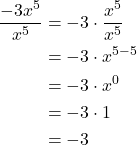
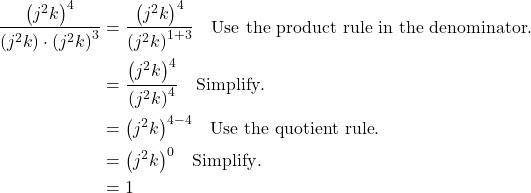
Use the zero exponent and other rules to simplify each expression.

Try It 4
Simplify each expression using the zero exponent rule of exponents.


Show Solution


Using the Negative Rule of Exponents
Another useful result occurs if we relax the condition that in the quotient rule even further. For example, can we simplify  When
When  —that is, where the difference is negative—we can use the negative rule of exponents to simplify the expression to its reciprocal.
Divide one exponential expression by another with a larger exponent. Use our example, 
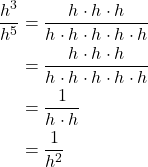
If we were to simplify the original expression using the quotient rule, we would have

Putting the answers together, we have  This is true for any nonzero real number, or any variable representing a nonzero real number.
A factor with a negative exponent becomes the same factor with a positive exponent if it is moved across the fraction bar—from numerator to denominator or vice versa.

We have shown that the exponential expression  is defined when
  is a natural number, 0, or the negative of a natural number. That means that is defined for any integer
  Also, the product and quotient rules and all of the rules we will look at soon hold for any integer
The Negative Rule of Exponents
For any nonzero real number and natural number the negative rule of exponents states that

Example 5
Using the Negative Exponent Rule
Write each of the following quotients with a single base. Do not simplify further. Write answers with positive exponents.


Solution



Try It 5
Write each of the following quotients with a single base. Do not simplify further. Write answers with positive exponents.


Show Solution


Example 6
Using the Product and Quotient Rules
Write each of the following products with a single base. Do not simplify further. Write answers with positive exponents.



Solution



Try It 6
Write each of the following products with a single base. Do not simplify further. Write answers with positive exponents.


Show Solution


Finding the Power of a Product
To simplify the power of a product of two exponential expressions, we can use the power of a product rule of exponents, which breaks up the power of a product of factors into the product of the powers of the factors. For instance, consider  We begin by using the associative and commutative properties of multiplication to regroup the factors.
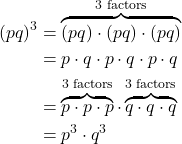
In other words, 
The Power of a Product Rule of Exponents
For any real numbers and  and any integer the power of a product rule of exponents states that

Example 7
Using the Power of a Product Rule
Simplify each of the following products as much as possible using the power of a product rule. Write answers with positive exponents.


Solution
Use the product and quotient rules and the new definitions to simplify each expression.





Try It 7
Simplify each of the following products as much as possible using the power of a product rule. Write answers with positive exponents.


Show Solution


Finding the Power of a Quotient
To simplify the power of a quotient of two expressions, we can use the power of a quotient rule, which states that the power of a quotient of factors is the quotient of the powers of the factors. For example, let’s look at the following example.
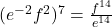
Let’s rewrite the original problem differently and look at the result.
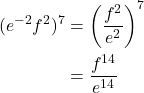
It appears from the last two steps that we can use the power of a product rule as a power of a quotient rule.
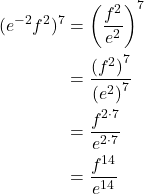
The Power of a Quotient Rule of Exponents
For any real numbers and and any integer the power of a quotient rule of exponents states that

Example 8
Using the Power of a Quotient Rule
Simplify each of the following quotients as much as possible using the power of a quotient rule. Write answers with positive exponents.


Solution





Try It 8
Simplify each of the following quotients as much as possible using the power of a quotient rule. Write answers with positive exponents.


Show Solution


Simplifying Exponential Expressions
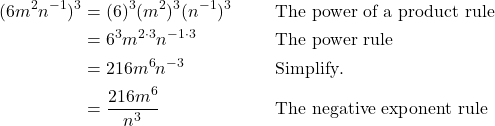
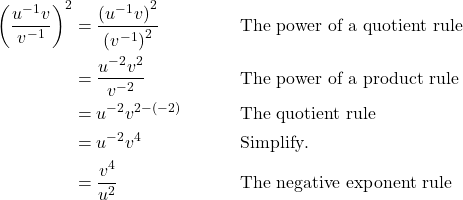
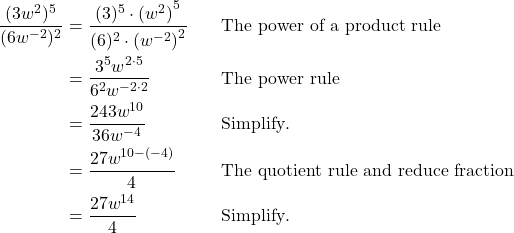
Recall that to simplify an expression means to rewrite it by combining terms or exponents; in other words, to write the expression more simply with fewer terms. The rules for exponents may be combined to simplify expressions.
Example 9
Simplifying Exponential Expressions
Simplify each expression and write the answer with positive exponents only.






Solution



Try It 9
Simplify each expression and write the answer with positive exponents only.





Show Solution


5.1 Exercise Set
- Is the same as
 ? Explain.
 - When can you add two exponents?
- What is the purpose of scientific notation?
- Explain what a negative exponent does.







- 0.0000314
- 148,000,000






Answers
- No, the two expressions are not the same. An exponent tells how many times you multiply the base. So is the same as
 , which is 8. is the same as
  , which is 9.
 - It is a method of writing very small and very large numbers.
- 81
- 243


- 1


- 16,000,000,000


Text Attribution
This text was adapted from Chapter 1.2 of Algebra and Trigonometry 2e, textbooks originally published by OpenStax.