
5.6 Quadratic Function
Learning Objectives
In this section, you will:
- Recognize characteristics of parabolas.
- Understand how the graph of a parabola is related to its quadratic function.
- Determine a quadratic function’s minimum or maximum value.
Curved antennas, such as the ones shown in Figure 1, are commonly used to focus microwaves and radio waves to transmit television and telephone signals, as well as satellite and spacecraft communication. The cross-section of the antenna is in the shape of a parabola, which can be described by a quadratic function.
In this section, we will investigate quadratic functions, which frequently model problems involving area and projectile motion. Working with quadratic functions can be less complex than working with higher degree functions, so they provide a good opportunity for a detailed study of function behavior.
Recognizing Characteristics of Parabolas
The graph of a quadratic function is a U-shaped curve called a parabola. One important feature of the graph is that it has an extreme point, called the vertex. If the parabola opens up, the vertex represents the lowest point on the graph, or the minimum value of the quadratic function. If the parabola opens down, the vertex represents the highest point on the graph, or the maximum value. In either case, the vertex is a turning point on the graph. The graph is also symmetric with a vertical line drawn through the vertex, called the axis of symmetry. These features are illustrated in Figure 2.
The y-intercept is the point at which the parabola crosses the y-axis. The x-intercepts are the points at which the parabola crosses the x-axis. If they exist, the x-intercepts represent the zeros, or roots, of the quadratic function, the values of x at which y = 0.
Example 1
Identifying the Characteristics of a Parabola
Determine the vertex, axis of symmetry, zeros, and y-intercept of the parabola shown in Figure 3.
Show/Hide Solution
The vertex is the turning point of the graph. We can see that the vertex is at (3, 1). Because this parabola opens upward, the axis of symmetry is the vertical line that intersects the parabola at the vertex. So the axis of symmetry is x = 3. This parabola does not cross the x-axis, so it has no zeros. It crosses the y-axis at (0, 7) so this is the y-intercept.
Understanding How the Graphs of Parabolas are Related to Their Quadratic Functions
The general form of a quadratic function presents the function in the form:
where a, b, and c are real numbers and a ≠ 0. If a > 0, the parabola opens upward. If a < 0, the parabola opens downward. We can use the general form of a parabola to find the equation for the axis of symmetry.
The axis of symmetry is defined by  . If we use the quadratic formula,
 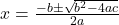 , to solve
  for the x-intercepts, or zeros, we find the value of x halfway between them is always , the equation for the axis of symmetry.
Figure 4 represents the graph of the quadratic function written in general form as  . In this form, a = 1, b = 4, and c = 3. Because a > 0, the parabola opens upward. The axis of symmetry is
 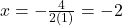 . This also makes sense because we can see from the graph that the vertical line x = -2 divides the graph in half. The vertex always occurs along the axis of symmetry. For a parabola that opens upward, the vertex occurs at the lowest point on the graph, in this instance, (-2, -1). The x-intercepts, those points where the parabola crosses the x-axis, occur at (-3, 0) and (-1, 0).
The standard form of a quadratic function presents the function in the form:
where (h, k) is the vertex. Because the vertex appears in the standard form of the quadratic function, this form is also known as the vertex form of a quadratic function.
As with the general form, if a > 0, the parabola opens upward and the vertex is a minimum. If a < 0, the parabola opens downward, and the vertex is a maximum. Figure 5 represents the graph of the quadratic function written in standard form as  . Since x – h = x + 2 in this example, h = -2. In this form, a = -3, h = -2, and k = 4. Because a < 0, the parabola opens downward. The vertex is at (-2, 4).
The standard form is useful for determining how the graph is transformed from the graph of  . Figure 6 is the graph of this basic function.
If k > 0, the graph shifts upward, whereas if k < 0, the graph shifts downward. In Figure 5, k > 0, so the graph is shifted 4 units upward. If h > 0, the graph shifts toward the right and if h < 0, the graph shifts to the left. In Figure 5, h < 0, so the graph is shifted 2 units to the left. The magnitude of a indicates the stretch of the graph. If |a| > 1, the point associated with a particular x-value shifts farther from the x-axis, so the graph appears to become narrower, and there is a vertical stretch. But if |a| < 1, the point associated with a particular x-value shifts closer to the x-axis, so the graph appears to become wider, but in fact there is a vertical compression. In Figure 5, |a| > 1, so the graph becomes narrower.
The standard form and the general form are equivalent methods of describing the same function. We can see this by expanding out the general form and setting it equal to the standard form.

For the linear terms to be equal, the coefficients must be equal.
 , so
, so 
This is the axis of symmetry we defined earlier. Setting the constant terms equal:
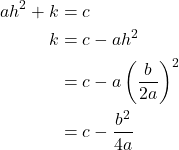
In practice, though, it is usually easier to remember that k is the output value of the function when the input is h, so f(h) = k.
Forms of Quadratic Functions
A quadratic function is a polynomial function of degree two. The graph of a quadratic function is a parabola.
The general form of a quadratic function is  where a, b, and c are real numbers and a ≠ 0.
The standard form of a quadratic function is  where a ≠ 0.
The vertex (h, k) is located at

Finding the Domain and Range of a Quadratic Function
Any number can be the input value of a quadratic function. Therefore, the domain of any quadratic function is all real numbers. Because parabolas have a maximum or a minimum point, the range is restricted. Since the vertex of a parabola will be either a maximum or a minimum, the range will consist of all y-values greater than or equal to the y-coordinate at the turning point or less than or equal to the y-coordinate at the turning point, depending on whether the parabola opens up or down.
Domain and Range of a Quadratic Function
The domain of any quadratic function is all real numbers unless the context of the function presents some restrictions.
The range of a quadratic function written in general form with a positive a value is  , or
, or 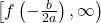 ; the range of a quadratic function written in general form with a negative a value is
  , or
, or ![\left(-\infty, f\left(-\frac{b}{2a}\right)\right]](https://foundations-of-math12.pressbooks.tru.ca/wp-content/ql-cache/quicklatex.com-4ee4af3469a83bef331727cfaf6e3e81_l3.png "Rendered by QuickLaTeX.com") .
.
The range of a quadratic function written in standard form with a positive a value is  ; the range of a quadratic function written in standard form with a negative a value is
  .
.
How To
Given a quadratic function, find the domain and range.
- Identify the domain of any quadratic function as all real numbers.
- Determine whether a is positive or negative. If a is positive, the parabola has a minimum. If a is negative, the parabola has a maximum.
- Determine the maximum or minimum value of the parabola, k.
- If the parabola has a minimum, the range is given by , or
 . If the parabola has a maximum, the range is given by , or
 ![(-\infty, k]](https://foundations-of-math12.pressbooks.tru.ca/wp-content/ql-cache/quicklatex.com-998a47ecd2218b7cd8fefd29b970f9dc_l3.png "Rendered by QuickLaTeX.com") .
.
Example 4
Finding the Domain and Range of a Quadratic Function
Find the domain and range of  .
.
Show/Hide Solution
As with any quadratic function, the domain is all real numbers.
Because a is negative, the parabola opens downward and has a maximum value. We need to determine the maximum value. We can begin by finding the x-value of the vertex.
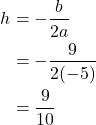
The maximum value is given by f(h).
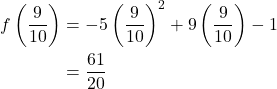
The range is  , or
, or ![\left(-\infty, \frac{61}{20}\right]](https://foundations-of-math12.pressbooks.tru.ca/wp-content/ql-cache/quicklatex.com-3c890ef92577fd6a392e978ffccc2cb7_l3.png "Rendered by QuickLaTeX.com") .
.
Try It 3
Find the domain and range of  .
.
Show Solution
 , or
, or  .
.Determining the Maximum and Minimum Values of Quadratic Functions
The output of the quadratic function at the vertex is the maximum or minimum value of the function, depending on the orientation of the parabola. We can see the maximum and minimum values in Figure 9.
Much as we did in the application problems above, we also need to find intercepts of quadratic equations for graphing parabolas. Recall that we find the y-intercept of a quadratic by evaluating the function at an input of zero, and we find the x-intercepts at locations where the output is zero. Notice in Figure 13 that the number of x-intercepts can vary depending upon the location of the graph.
How To
Given a quadratic function f(x), find the y– and x-intercepts.
- Evaluate f(0) to find the y-intercept.
- Solve the quadratic equation f(x) = 0 to find the x-intercepts.
Example 7
Finding the y– and x-Intercepts of a Parabola
Find the y– and x-intercepts of the quadratic  .
.
Show/Hide Solution
We find the y-intercept by evaluating f(0).
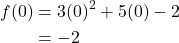
So the y-intercept is at (0, -2).
For the x-intercepts, we find all solutions of f(x) = 0.

In this case, the quadratic can be factored easily, providing the simplest method for solution.

So the x-intercepts are at  and (-2, 0).
Media
Access these online resources for additional instruction and practice with quadratic equations.
5.6 Exercise Set
- Explain the advantage of writing a quadratic function in standard form.
- How can the vertex of a parabola be used in solving real-world problems?
- Explain why the condition of
 is imposed in the definition of the quadratic function.
 - What is another name for the standard form of a quadratic function?
- What two algebraic methods can be used to find the horizontal intercepts of a quadratic function?
For the following exercises, rewrite the quadratic functions in standard form and give the vertex.








For the following exercises, determine whether there is a minimum or maximum value to each quadratic function. Find the value and the axis of symmetry.







Text Attribution
This text was adapted from Chapter 5.1 of Algebra and Trigonometry 2e, textbooks originally published by OpenStax.