
7.1 Angles – do todo’s
Learning Objectives
After completing this section, you should be able to…
- Draw angles in standard position.
- Convert between degrees and radians.
A golfer swings to hit a ball over a sand trap and onto the green. An airline pilot maneuvers a plane toward a narrow runway. A dress designer creates the latest fashion. What do they all have in common? They all work with angles, and so do all of us at one time or another. Sometimes we need to measure angles exactly with instruments. Other times we estimate them or judge them by eye. Either way, the proper angle can make the difference between success and failure in many undertakings. In this section, we will examine properties of angles.
Drawing Angles in Standard Position
Properly defining an angle first requires that we define a ray. A ray is a directed line segment. It consists of one point on a line and all points extending in one direction from that point. The first point is called the endpoint of the ray. We can refer to a specific ray by stating its endpoint and any other point on it. The ray in Figure 1 can be named as ray EF, or in symbol form  .
.
An angle is the union of two rays having a common endpoint. The endpoint is called the vertex of the angle, and the two rays are the sides of the angle. The angle in Figure 2 is formed from  and . Angles can be named using a point on each ray and the vertex, such as angle DEF, or in symbol form
Greek letters are often used as variables for the measure of an angle. Table 1 is a list of Greek letters commonly used to represent angles, and a sample angle is shown in Figure 3.
 |
 or or  |
 |
 |
 |
|---|---|---|---|---|
| theta | phi | alpha | beta | gamma |

Angle creation is a dynamic process. We start with two rays lying on top of one another. We leave one fixed in place, and rotate the other. The fixed ray is the initial side, and the rotated ray is the terminal side. In order to identify the different sides, we indicate the rotation with a small arrow close to the vertex as in Figure 4.
As we discussed at the beginning of the section, there are many applications for angles, but in order to use them correctly, we must be able to measure them. The measure of an angle is the amount of rotation from the initial side to the terminal side. Probably the most familiar unit of angle measurement is the degree. One degree is  of a circular rotation, so a complete circular rotation contains
  degrees. An angle measured in degrees should always include the unit “degrees” after the number, or include the degree symbol
  For example,
To formalize our work, we will begin by drawing angles on an x–y coordinate plane. Angles can occur in any position on the coordinate plane, but for the purpose of comparison, the convention is to illustrate them in the same position whenever possible. An angle is in standard position if its vertex is located at the origin, and its initial side extends along the positive x-axis. See Figure 5.
If the angle is measured in a counterclockwise direction from the initial side to the terminal side, the angle is said to be a positive angle. If the angle is measured in a clockwise direction, the angle is said to be a negative angle.
Drawing an angle in standard position always starts the same way—draw the initial side along the positive x-axis. To place the terminal side of the angle, we must calculate the fraction of a full rotation the angle represents. We do that by dividing the angle measure in degrees by  For example, to draw a
  angle, we calculate that
  So, the terminal side will be one-fourth of the way around the circle, moving counterclockwise from the positive x-axis. To draw a
  angle, we calculate that
  So the terminal side will be 1 complete rotation around the circle, moving counterclockwise from the positive x-axis. In this case, the initial side and the terminal side overlap. See Figure 6.
Since we define an angle in standard position by its terminal side, we have a special type of angle whose terminal side lies on an axis, a quadrantal angle. This type of angle can have a measure of 0°, 90°, 180°, 270°, or 360°. See Figure 7.
Quadrantal Angles
An angle is a quadrantal angle if its terminal side lies on an axis, including 0°, 90°, 180°, 270°, or 360°.
How To
Given an angle measure in degrees, draw the angle in standard position.
- Express the angle measure as a fraction of

- Reduce the fraction to simplest form.
- Draw an angle that contains that same fraction of the circle, beginning on the positive x-axis and moving counterclockwise for positive angles and clockwise for negative angles.
Example 1
Drawing an Angle in Standard Position Measured in Degrees
- ⓐSketch an angle of
 in standard position.
 - ⓑSketch an angle of
 in standard position.
Solution
- ⓐDivide the angle measure by [latex]\frac{30°}{360°}=\frac{1}{12}[/latex]To rewrite the fraction in a more familiar fraction, we can recognize that
 One-twelfth equals one-third of a quarter, so by dividing a quarter rotation into thirds, we can sketch a line at
  as in Figure 8.
Figure 8 - ⓑDivide the angle measure by [latex]\frac{−135°}{360°}=−\frac{3}{8}[/latex]In this case, we can recognize that
 Three-eighths is one and one-half times a quarter, so we place a line by moving clockwise one full quarter and one-half of another quarter, as in Figure 9.
Figure 9
Try It 1
Show an angle of  on a circle in standard position.
Show Solution
Converting Between Degrees and Radians
Dividing a circle into 360 parts is an arbitrary choice, although it creates the familiar degree measurement. We may choose other ways to divide a circle. To find another unit, think of the process of drawing a circle. Imagine that you stop before the circle is completed. The portion that you drew is referred to as an arc. An arc may be a portion of a full circle, a full circle, or more than a full circle, represented by more than one full rotation. The length of the arc around an entire circle is called the circumference of that circle.
The circumference of a circle is  If we divide both sides of this equation by
  we create the ratio of the circumference, which is always
  to the radius, regardless of the length of the radius. So the circumference of any circle is
  times the length of the radius. That means that if we took a string as long as the radius and used it to measure consecutive lengths around the circumference, there would be room for six full string-lengths and a little more than a quarter of a seventh, as shown in Figure 10.
This brings us to our new angle measure. One radian is the measure of a central angle of a circle that intercepts an arc equal in length to the radius of that circle. A central angle is an angle formed at the center of a circle by two radii. Because the total circumference equals  times the radius, a full circular rotation is radians.
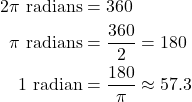
See Figure 11. Note that when an angle is described without a specific unit, it refers to radian measure. For example, an angle measure of 3 indicates 3 radians. In fact, radian measure is dimensionless, since it is the quotient of a length (circumference) divided by a length (radius) and the length units cancel.
 sweeps out a measure of one radian. Note that the length of the intercepted arc is the same as the length of the radius of the circle.
Relating Arc Lengths to Radius
An arc length  is the length of the curve along the arc. Just as the full circumference of a circle always has a constant ratio to the radius, the arc length produced by any given angle also has a constant relation to the radius, regardless of the length of the radius.
This ratio, called the radian measure, is the same regardless of the radius of the circle—it depends only on the angle. This property allows us to define a measure of any angle as the ratio of the arc length to the radius r. See Figure 12.

If  then
then 
equals the radius  (b) An angle of 2 radians has an arc length
  (c) A full revolution is or about 6.28 radians.
To elaborate on this idea, consider two circles, one with radius 2 and the other with radius 3. Recall the circumference of a circle is  where
where  is the radius. The smaller circle then has circumference
  and the larger has circumference
  Now we draw a
  angle on the two circles, as in Figure 13.
angle contains one-eighth of the circumference of a circle, regardless of the radius.Notice what happens if we find the ratio of the arc length divided by the radius of the circle.
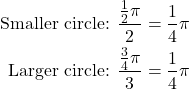
Since both ratios are  the angle measures of both circles are the same, even though the arc length and radius differ.
Radians
One radian is the measure of the central angle of a circle such that the length of the arc between the initial side and the terminal side is equal to the radius of the circle. A full revolution  equals radians. A half revolution
  is equivalent to
  radians.
The radian measure of an angle is the ratio of the length of the arc subtended by the angle to the radius of the circle. In other words, if is the length of an arc of a circle, and is the radius of the circle, then the central angle containing that arc measures  radians. In a circle of radius 1, the radian measure corresponds to the length of the arc.
Q&A
A measure of 1 radian looks to be about  Is that correct?
Yes. It is approximately  Because radians equals
  radian equals
Using Radians
Because radian measure is the ratio of two lengths, it is a unitless measure. For example, in Figure 12, suppose the radius were 2 inches and the distance along the arc were also 2 inches. When we calculate the radian measure of the angle, the “inches” cancel, and we have a result without units. Therefore, it is not necessary to write the label “radians” after a radian measure, and if we see an angle that is not labeled with “degrees” or the degree symbol, we can assume that it is a radian measure.
Considering the most basic case, the unit circle (a circle with radius 1), we know that 1 rotation equals 360 degrees, We can also track one rotation around a circle by finding the circumference, and for the unit circle  These two different ways to rotate around a circle give us a way to convert from degrees to radians.
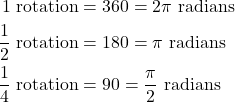
Identifying Special Angles Measured in Radians
In addition to knowing the measurements in degrees and radians of a quarter revolution, a half revolution, and a full revolution, there are other frequently encountered angles in one revolution of a circle with which we should be familiar. It is common to encounter multiples of 30, 45, 60, and 90 degrees. These values are shown in Figure 14. Memorizing these angles will be very useful as we study the properties associated with angles.
Now, we can list the corresponding radian values for the common measures of a circle corresponding to those listed in Figure 14, which are shown in Figure 15. Be sure you can verify each of these measures.
Example 2
Finding a Radian Measure
Find the radian measure of one-third of a full rotation.
Solution
For any circle, the arc length along such a rotation would be one-third of the circumference. We know that

So,

The radian measure would be the arc length divided by the radius.
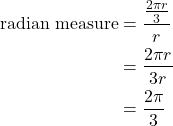
Try It 2
Find the radian measure of three-fourths of a full rotation.
Show Solution

Converting Between Radians and Degrees
Because degrees and radians both measure angles, we need to be able to convert between them. We can easily do so using a proportion where is the measure of the angle in degrees and  is the measure of the angle in radians.

This proportion shows that the measure of angle in degrees divided by 180 equals the measure of angle in radians divided by  Or, phrased another way, degrees is to 180 as radians is to

Converting between Radians and Degrees
To convert between degrees and radians, use the proportion

Example 3
Converting Radians to Degrees
Convert each radian measure to degrees.
-

- 3
Solution
Because we are given radians and we want degrees, we should set up a proportion and solve it.
- We use the proportion, substituting the given information.
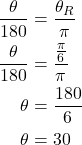
- We use the proportion, substituting the given information.
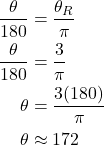
Try It 3
Convert  radians to degrees.
Show Solution

Example 4
Converting Degrees to Radians
Convert  degrees to radians.
Solution
In this example, we start with degrees and want radians, so we again set up a proportion, but we substitute the given information into a different part of the proportion.
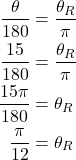
Analysis
Another way to think about this problem is by remembering that  Because
  we can find that
  is
is 
Try It 4
Convert  to radians.
Show Solution

#TODO: Get answers from https://openstax.org/books/algebra-and-trigonometry-2e/pages/6-5-logarithmic-properties
Text Attribution
This text was adapted from Chapter 7.1 of Algebra and Trigonometry 2e, textbooks originally published by OpenStax.