
2.4 Combinations – NOTE – Double check the answers
Learning Objectives
After completing this section, you should be able to:
- Distinguish between permutation and combination uses.
- Compute combinations.
- Apply combinations to solve applications.
In Permutations, we studied permutations, which we use to count the number of ways to generate an ordered list of a given length from a group of objects. An important property of permutations is that the order of the list matters: The results of a race and the selection of club officers are examples of lists where the order is important. In other situations, the order is not important. For example, in most card games where a player receives a hand of cards, the order in which the cards are received is irrelevant; in fact, players often rearrange the cards in a way that helps them keep the cards organized.
Combinations: When Order Doesn’t Matter
In situations in which the order of a list of objects doesn’t matter, the lists are no longer permutations. Instead, we call them combinations.
Example 1
For each of the following situations, decide whether the chosen subset is a permutation or a combination.
- A social club selects 3 members to form a committee. Each of the members has an equal share of responsibility.
- You are prompted to reset your email password; you select a password consisting of 10 characters without repeats.
- At a dog show, the judge must choose first-, second-, and third-place finishers from a group of 16 dogs.
- At a restaurant, the special of the day comes with the customer’s choice of 3 sides taken from a list of 6 possibilities.
Show/Hide Solution
- Since there is no distinction among the responsibilities of the 3 committee members, the order isn’t important. So, this is a combination.
- The order of the characters in a password matter, so this is a permutation.
- The order of finish matters in a dog show, so this is a permutation.
- A plate with mashed potatoes, peas, and broccoli is functionally the same as a plate with peas, broccoli, and mashed potatoes, so this is a combination.
Try It 1
Decide whether the following represent permutations or combinations:
- On Halloween, you give each kid who comes to your door 3 pieces of candy, taken randomly from a candy dish.
- Your class is going on a field trip, but there are too many people for one vehicle. Your instructor chooses half the class to take the first vehicle.
Show/Hide Solution
- The order isn’t important. So, this is a combination.
- The order matters, so it is permutation.
Counting Combinations
Permutations and combinations are certainly related, because they both involve choosing a subset of a large group. Let’s explore that connection, so that we can figure out how to use what we know about permutations to help us count combinations. We’ll take a basic example. How many ways can we select 3 letters from the group A, B, C, D, and E? If order matters, that number is  . That’s small enough that we can list them all out in the table below.
| ABC | ABD | ABE | ACB | ACD | ACE |
| ADB | ADC | ADE | AEB | AEC | AED |
| BAC | BAD | BAE | BCA | BCD | BCE |
| BDA | BDC | BDE | BEA | BEC | BED |
| CAB | CAD | CAE | CBA | CBD | CBE |
| CDA | CDB | CDE | CEA | CEB | CED |
| DCA | DAC | DAE | DBA | DBC | DBE |
| DCA | DCB | DCE | DEA | DEB | DEC |
| EAB | EAC | EAD | EBA | EBC | EBD |
| ECA | ECB | ECD | EDA | EDB | EDC |
Now, let’s look back at that list and color-code it so that groupings of the same 3 letters get the same color, as shown in Figure 7.9:
After color-coding, we see that the 60 cells can be seen as 10 groups (colors) of 6. That’s no coincidence! We’ve already seen how to compute the number of permutations using the formula. To compute the number of combinations, let’s count them another way using the Multiplication Rule for Counting. We’ll do this in two steps:
Step 1: Choose 3 letters (paying no attention to order).
Step 2: Put those letters in order.
The number of ways to choose 3 letters from this group of 5 (A, B, C, D, E) is the number of combinations we’re looking for; let’s call that number  (read “the number of combinations of 5 objects taken 3 at a time”). We can see from our chart that this is ten (the number of colors used). We can generalize our findings this way: remember that the number of permutations of
  things taken
  at a time is
  . That number is also equal to
  , and so it must be the case that
 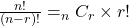 . Dividing both sides of that equation by
  gives us the formula below.

Example 2
Compute the following:


Show/Hide Solution



Try It 2
Compute the following:


Show/Hide Solution
- 15
- 45
- 2002
Example 3
- In the card game Texas Hold’em (a variation of poker), players are dealt 2 cards from a standard deck to form their hands. How many different hands are possible?
- The board game Clue uses a deck of 21 cards. If 3 people are playing, each person gets 6 cards for their hand. How many different 6-card Clue hands are possible?
- Palmetto Cash 5 is a game offered by the South Carolina Education Lottery. Players choose 5 numbers from the whole numbers between 1 and 38 (inclusive); the player wins the jackpot of $100,000 if the randomizer selects those numbers in any order. How many different sets of winning numbers are possible?
Show/Hide Solution
- A standard deck has 52 cards, and a hand has 2 cards. Since the order doesn’t matter:

- Again, the order doesn’t matter:

- There are 38 numbers to choose from, and we must pick 5:

Try It 3
- At a charity event with 58 people in attendance, 3 raffle winners are chosen. All receive the same prize, so order doesn’t matter. How many different groups of 3 winners can be chosen?
- A sorority with 42 members needs to choose a committee with 4 members, each with equal responsibility. How many committees are possible?
Show/Hide Solution
- 30856
- 111930
Checkpoint
The notation and nomenclature used for the number of combinations is not standard across all sources. You’ll sometimes see  instead of
  . Sometimes you’ll hear that expression read as “ choose ” as shorthand for “the number of combinations of objects taken at a time.”
People in Mathematics
Early Eastern Mathematicians
Although combinations weren’t really studied in Europe until around the 13th century, mathematicians of the Middle and Far East had already been working on them for hundreds of years. The Indian mathematician known as Pingala had described them by the second century BCE; Varāhamihira (fl. sixth century) and Halayudha (fl. 10th century) extended Pingala’s work. In the ninth century, a Jain mathematician named Mahāvīra gave the formula for combinations that we use today.
In 10th-century Baghdad, a mathematician named Al-Karaji also knew formulas for combinations; though his work is now lost, it was known to (and repeated by) Persian mathematician Omar Khayyam, whose work survives. Khayyam is probably best remembered as a poet, with his Rubaiyat being his most famous work.
Meanwhile, in 11th-century China, Jia Xian also was working with combinations, as was his 13th-century successor Yang Hui.
It is not known whether the discoveries of any of these men were known in the other regions, or if the Indians, Persians, and Chinese all came to their discoveries independently. We do know that mathematical knowledge and sometimes texts did get passed along trade routes, so it can’t be ruled out.
Example 4
The student government at a university consists of 10 seniors, 8 juniors, 6 sophomores, and 4 first-years.
- How many ways are there to choose a committee of 8 people from this group?
- How many ways are to choose a committee of 8 people if the committee must consist of 2 people from each class?
Show/Hide Solution
- There are 28 people to choose from, and we need 8. So, the number of possible committees is
 .
. - Break the selection down into a 4-step process:
Class Number of Ways to Choose senior 
junior 
sophomore 
first-year 
The Multiplication Rule for Counting tells us to multiply:
 possible committees.
Try It 4
How many ways are there to choose a hand of 6 cards from a standard deck with the constraint that 3 are ♠, 2 are ♡, and 1 is ♣?
Show/Hide Solution

Check Your Understanding
- Suppose you want to count the number of ways that you can arrange the apps on the home screen on your phone. Should you use permutations or combinations?
- Your little brother is packing up for a family vacation, but there’s only room for 3 of his toys. If you want to know how many possible groups of toys he can bring, should you use permutations or combinations?
- Compute
 .
. - Compute
 .
. - You’re planning a road trip with some friends. Though you have 6 friends you’d consider bringing along, you only have room for 3 other people in the car. How many different possibilities are there for your road trip squad?
- You’re packing for a trip, for which you need 3 shirts and 3 skirts. If you have 8 shirts and 5 skirts that would work for the trip, how many different ways are there to pack for the trip?
#TODO: PUT THE SHOW/ HIDE HERE
1. permutations (order matters).
2. combinations (order does not matter).
3. 66
4. 560
5. 20
6. 560
2.4 Exercise Set
For the following exercises, decide whether the situation describes a permutation or a combination.
- You’re packing for vacation, and you need to pick 5 shirts.
- You and your friends are about to play a game, and you need to decide who will have the first turn, second turn, and so on.
- You are watching your favorite reality show, and you want to know how many possibilities there are for the order of finish for the top three.
- You are going to be working in groups of 4 with your classmates, and you want to know how many possibilities there are for the composition of your group.
For the following exercises, express your answers as whole numbers.


- In most variations of the card game poker, a hand consists of 5 cards, where the order doesn’t matter. How many different poker hands are there?
- A professor starts each class by choosing 3 students to present solutions to homework problems to the class. If there are 41 students in the class, in how many different ways can the professor make those selections?
- An election for at-large members of a school board has 7 candidates; 3 will be elected. How many different ways can those 3 seats be filled?
- There are 20 contestants on a reality TV show; at the end of the first episode, 10 are eliminated. How many different groups of eliminated contestants are possible?
- At a horse race, bettors can place a bet called an exacta box. For this bet, the player chooses 2 horses; if those horses finish first and second (in either order), the player wins. In a race with 12 horses in the field, how many possible exactas box bets are there?
The following exercises are about the card game euchre, which uses a partial standard deck of cards: it only has the cards with ranks 9, 10, J, Q, K, and A (for a total of 24 cards).
- A euchre hand contains 5 cards. How many ways are there to receive a 5-card hand (where the order in which the cards are received doesn’t matter)?
- After all 4 players get their hands, the remaining 4 cards are placed face down in the center of the table. How many different groups of 4 cards are there from this deck?
- Euchre is played with partners. How many ways are there for 2 partners to receive 5-card hands? Hint: After the first person gets their cards, there are
 cards left for the second person.
  .
.
You and 5 of your friends are at an amusement park, and are about to ride a roller coaster. The cars have room for 6 people arranged in 3 rows of 2, so you and your friends will perfectly fill one car.
- How many ways are there to choose the 2 people in the front row?
- Assuming the front row has been selected, how many ways are there to choose the 2 people in the middle row?
- Assuming the first 2 rows have been selected, how many ways are there to choose the 2 people in the back row?
- How many different committees of 4 are possible, assuming all of the duties are shared equally?
The University Combinatorics Club has 18 members. Four of them will be selected to form a committee.
- Instead of sharing responsibility equally, one person will be chosen to be the committee chair. How many different committees are possible? Count these by selecting a chair first, then selecting the remaining 3 members of the committee from the remaining club members and use the Multiplication Rule for Counting. Show your work.
- Let’s count the number of committees with chairs a different way: First, choose 4 people for the committee (as in the first question), then choose 1 of the 4 to be chair. Show your work. Do you get the same number?
Powerball® is a multistate lottery game, which costs $2 to play. Players fill out a ticket by choosing 5 numbers between 1 and 69 (these are the white balls) and then a single number between 1 and 26 (this is the Powerball)
- How many different ways are there to choose the white balls? Players who match these 5 numbers exactly (but not the Powerball) win $1 million.
- How many ways are there to choose the Powerball? Players who correctly pick the Powerball win $4.
- How many ways are there to play the game altogether? Players who match all 5 white balls and the Powerball win (or share) the grand prize.
- You are in charge of programming for a music festival. The festival has a main stage, a secondary stage, and several smaller stages. There are 40 bands confirmed for the festival. Five of those will play the main stage, and 8 will play the secondary stage. How many ways are there for you to allocate bands to these 2 stages?
Answers
#TODO fix the numbering
-
-
- combination (order doesn’t matter).
- permutation (order matters).
- permutation (order matters).
- combination.
- 10
- 28
- 28
- 220
- 792
- 364
- 1001
- 3003
- 105
- 816
- 18564
- 4845
- 2598960
- 10660
- 35
- 184756
- 66
- 42504
- 10626
- 494236512
- 15
- 6
- 1
- 90
- 3060
- 12240
- 11238513
- 292201338
- 15,486,757,846,560
-
7. combination (order doesn’t matter).
8. permutation (order matters).
9. permutation (order matters).
10. combination.
11. 10
12. 28
13. 28
14. 220
15. 792
16. 364
17. 1001
18. 3003
19. 105
20. 816
21. 18564
22. 4845
22. 2598960
23. 10660
24. 35
25. 184756
26. 66
27. 42504
28. 10626
29. 494236512
30. 15
31. 6
32. 1
33. 90
34. 3060
35. 12240
36. 11238513
37. 292201338
38. 15,486,757,846,560
Attribution
Text Attribution
This text was adapted from Chapter 7.3 of Contemporary Mathematics, textbooks originally published by OpenStax.