
7.4 The Other Trigonometric Functions – fix background – do the todos
Learning Objectives
After completing this section, you should be able to…
- Find exact values of the trigonometric functions secant, cosecant, tangent, and cotangent of
 and
and 
- Use reference angles to evaluate the trigonometric functions secant, tangent, and cotangent.
- Use properties of even and odd trigonometric functions.
- Recognize and use fundamental identities.
- Evaluate trigonometric functions with a calculator.
A wheelchair ramp that meets the standards of the Americans with Disabilities Act must make an angle with the ground whose tangent is  or less, regardless of its length. A tangent represents a ratio, so this means that for every 1 inch of rise, the ramp must have 12 inches of run. Trigonometric functions allow us to specify the shapes and proportions of objects independent of exact dimensions. We have already defined the sine and cosine functions of an angle. Though sine and cosine are the trigonometric functions most often used, there are four others. Together they make up the set of six trigonometric functions. In this section, we will investigate the remaining functions.
Finding Exact Values of the Trigonometric Functions Secant, Cosecant, Tangent, and Cotangent
We can also define the remaining functions in terms of the unit circle with a point  corresponding to an angle of
  as shown in Figure 1. As with the sine and cosine, we can use the coordinates to find the other functions.
The first function we will define is the tangent. The tangent of an angle is the ratio of the y-value to the x-value of the corresponding point on the unit circle. In Figure 1, the tangent of angle  is equal to
  Because the y-value is equal to the sine of and the x-value is equal to the cosine of the tangent of angle can also be defined as
 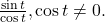 The tangent function is abbreviated as
  The remaining three functions can all be expressed as reciprocals of functions we have already defined.
- The secant function is the reciprocal of the cosine function. In Figure 1, the secant of angle is equal to
 The secant function is abbreviated as
- The cotangent function is the reciprocal of the tangent function. In Figure 1, the cotangent of angle is equal to
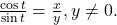 The cotangent function is abbreviated as
- The cosecant function is the reciprocal of the sine function. In Figure 1, the cosecant of angle is equal to
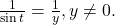 The cosecant function is abbreviated as
If is a real number and is a point where the terminal side of an angle of radians intercepts the unit circle, then 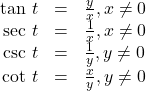
Example 1
Finding Trigonometric Functions from a Point on the Unit Circle
The point  is on the unit circle, as shown in Figure 2. Find
  and
and 
Solution
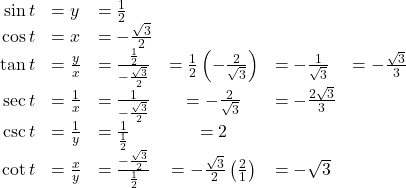
Because we know the coordinates of the point on the unit circle indicated by angle we can use those coordinates to find the six functions:
Try It 1
The point  is on the unit circle, as shown in Figure 3. Find and
Show Solution

Example 2
Finding the Trigonometric Functions of an Angle
Find and when 
Solution
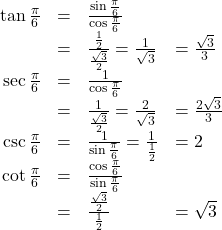
We have previously used the properties of equilateral triangles to demonstrate that  and
and  We can use these values and the definitions of tangent, secant, cosecant, and cotangent as functions of sine and cosine to find the remaining function values.
Try It 2
Find and when 
Show Solution

Because we know the sine and cosine values for the common first-quadrant angles, we can find the other function values for those angles as well by setting  equal to the cosine and
  equal to the sine and then using the definitions of tangent, secant, cosecant, and cotangent. The results are shown in Table 1.
| Angle |  |
 |
 |
 |
 |
|---|---|---|---|---|---|
| Cosine | 1 |  |
 |
 |
0 |
| Sine | 0 | |
|
|
1 |
| Tangent | 0 |  |
1 |  |
Undefined |
| Secant | 1 |  |
 |
2 | Undefined |
| Cosecant | Undefined | 2 | |
|
1 |
| Cotangent | Undefined | |
1 | |
0 |
Using Reference Angles to Evaluate Tangent, Secant, Cosecant, and Cotangent
We can evaluate trigonometric functions of angles outside the first quadrant using reference angles as we have already done with the sine and cosine functions. The procedure is the same: Find the reference angle formed by the terminal side of the given angle with the horizontal axis. The trigonometric function values for the original angle will be the same as those for the reference angle, except for the positive or negative sign, which is determined by x– and y-values in the original quadrant. Figure 4 shows which functions are positive in which quadrant.
To help remember which of the six trigonometric functions are positive in each quadrant, we can use the mnemonic phrase “A Smart Trig Class.” Each of the four words in the phrase corresponds to one of the four quadrants, starting with quadrant I and rotating counterclockwise. In quadrant I, which is “A,” all of the six trigonometric functions are positive. In quadrant II, “Smart,” only sine and its reciprocal function, cosecant, are positive. In quadrant III, “Trig,” only tangent and its reciprocal function, cotangent, are positive. Finally, in quadrant IV, “Class,” only cosine and its reciprocal function, secant, are positive.
Given an angle not in the first quadrant, use reference angles to find all six trigonometric functions.
- Measure the angle formed by the terminal side of the given angle and the horizontal axis. This is the reference angle.
- Evaluate the function at the reference angle.
- Observe the quadrant where the terminal side of the original angle is located. Based on the quadrant, determine whether the output is positive or negative.
Example 3
Using Reference Angles to Find Trigonometric Functions
Use reference angles to find all six trigonometric functions of 
Solution
The angle between this angle’s terminal side and the x-axis is  so that is the reference angle. Since
  is in the third quadrant, where both and are negative, cosine, sine, secant, and cosecant will be negative, while tangent and cotangent will be positive.

Try It 3
Use reference angles to find all six trigonometric functions of 
Show Solution

Using Even and Odd Trigonometric Functions
To be able to use our six trigonometric functions freely with both positive and negative angle inputs, we should examine how each function treats a negative input. As it turns out, there is an important difference among the functions in this regard.
Consider the function  shown in Figure 5. The graph of the function is symmetrical about the y-axis. All along the curve, any two points with opposite x-values have the same function value. This matches the result of calculation:
  and so on. So
  is an even function, a function such that two inputs that are opposites have the same output. That means
is an even function.Now consider the function  shown in Figure 6. The graph is not symmetrical about the y-axis. All along the graph, any two points with opposite x-values also have opposite y-values. So
  is an odd function, one such that two inputs that are opposites have outputs that are also opposites. That means
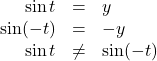
is an odd function.We can test whether a trigonometric function is even or odd by drawing a unit circle with a positive and a negative angle, as in Figure 7. The sine of the positive angle is  The sine of the negative angle is
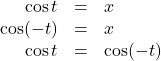
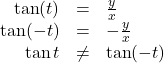
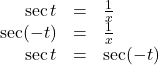
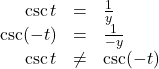
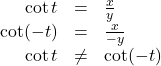
  The sine function, then, is an odd function. We can test each of the six trigonometric functions in this fashion. The results are shown in Table 2.
 |
 |
 |
 |
 |
 |
An even function is one in which
An odd function is one in which
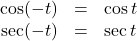
Cosine and secant are even:
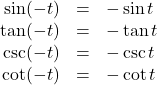
Sine, tangent, cosecant, and cotangent are odd:
Example 4
Using Even and Odd Properties of Trigonometric Functions
If the secant of angle is 2, what is the secant of 
Solution
Secant is an even function. The secant of an angle is the same as the secant of its opposite. So if the secant of angle is 2, the secant of  is also 2.
Try It 4
If the cotangent of angle is  what is the cotangent of
Show Solution

Recognizing and Using Fundamental Identities
We have explored a number of properties of trigonometric functions. Now, we can take the relationships a step further, and derive some fundamental identities. Identities are statements that are true for all values of the input on which they are defined. Usually, identities can be derived from definitions and relationships we already know. For example, the Pythagorean Identity we learned earlier was derived from the Pythagorean Theorem and the definitions of sine and cosine.
We can derive some useful identities from the six trigonometric functions. The other four trigonometric functions can be related back to the sine and cosine functions using these basic relationships:



Example 5
Using Identities to Evaluate Trigonometric Functions
- ⓐ Given
 evaluate
- ⓑ Given
 evaluate
Solution
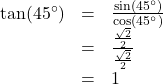
Because we know the sine and cosine values for these angles, we can use identities to evaluate the other functions.
- ⓐ
- ⓑ
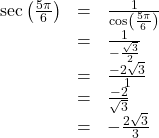
Try It 5
Evaluate 
Show Solution
Example 6
Using Identities to Simplify Trigonometric Expressions
Simplify 
Solution
We can simplify this by rewriting both functions in terms of sine and cosine.

By showing that  can be simplified to
  we have, in fact, established a new identity.

Try It 6
Simplify 
Show Solution

Alternate Forms of the Pythagorean Identity
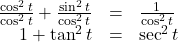
We can use these fundamental identities to derive alternate forms of the Pythagorean Identity,  One form is obtained by dividing both sides by
The other form is obtained by dividing both sides by 
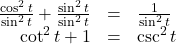
Alternate Forms of the Pythagorean Identity


Example 7
Using Identities to Relate Trigonometric Functions
If  and is in quadrant IV, as shown in Figure 8, find the values of the other five trigonometric functions.
Solution
We can find the sine using the Pythagorean Identity,  and the remaining functions by relating them to sine and cosine.
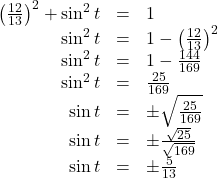
The sign of the sine depends on the y-values in the quadrant where the angle is located. Since the angle is in quadrant IV, where the y-values are negative, its sine is negative, 
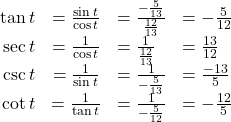
The remaining functions can be calculated using identities relating them to sine and cosine.
Try It 7
If  and
and  find the values of the other five functions.
Show Solution

As we discussed at the beginning of the chapter, a function that repeats its values in regular intervals is known as a periodic function. The trigonometric functions are periodic. For the four trigonometric functions, sine, cosine, cosecant and secant, a revolution of one circle, or  will result in the same outputs for these functions. And for tangent and cotangent, only a half a revolution will result in the same outputs.
Other functions can also be periodic. For example, the lengths of months repeat every four years. If represents the length time, measured in years, and  represents the number of days in February, then
  This pattern repeats over and over through time. In other words, every four years, February is guaranteed to have the same number of days as it did 4 years earlier. The positive number 4 is the smallest positive number that satisfies this condition and is called the period. A period is the shortest interval over which a function completes one full cycle—in this example, the period is 4 and represents the time it takes for us to be certain February has the same number of days.
Period of a function
The period  of a repeating function
  is the number representing the interval such that
  for any value of
The period of the cosine, sine, secant, and cosecant functions is 
The period of the tangent and cotangent functions is 
Example 8
Finding the Values of Trigonometric Functions
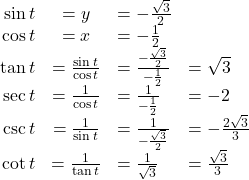
Find the values of the six trigonometric functions of angle based on Figure 9.
Solution
Try It 8
Find the values of the six trigonometric functions of angle based on Figure 10.
Show Solution

Example 9
Finding the Value of Trigonometric Functions
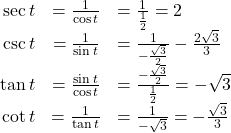
If 
Solution
Try It 9

Show Solution

Evaluating Trigonometric Functions with a Calculator
We have learned how to evaluate the six trigonometric functions for the common first-quadrant angles and to use them as reference angles for angles in other quadrants. To evaluate trigonometric functions of other angles, we use a scientific or graphing calculator or computer software. If the calculator has a degree mode and a radian mode, confirm the correct mode is chosen before making a calculation.
Evaluating a tangent function with a scientific calculator as opposed to a graphing calculator or computer algebra system is like evaluating a sine or cosine: Enter the value and press the TAN key. For the reciprocal functions, there may not be any dedicated keys that say CSC, SEC, or COT. In that case, the function must be evaluated as the reciprocal of a sine, cosine, or tangent.
If we need to work with degrees and our calculator or software does not have a degree mode, we can enter the degrees multiplied by the conversion factor  to convert the degrees to radians. To find the secant of
  we could press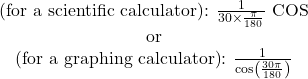
#TODO: fix the latex formatting issues around here
Given an angle measure in radians, use a scientific calculator to find the cosecant.
- If the calculator has degree mode and radian mode, set it to radian mode.
- Enter:

- Enter the value of the angle inside parentheses.
- Press the SIN key.
- Press the = key.
Given an angle measure in radians, use a graphing utility/calculator to find the cosecant.
- If the graphing utility has degree mode and radian mode, set it to radian mode.
- Enter:
- Press the SIN key.
- Enter the value of the angle inside parentheses.
- Press the ENTER key.
Example 10
Evaluating the Cosecant Using Technology
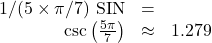
Evaluate the cosecant of 
Solution
For a scientific calculator, enter information as follows:
Try It 10
Evaluate the cotangent of 
Show Solution

7.4 Exercises Set
- On an interval of
 can the sine and cosine values of a radian measure ever be equal? If so, where?
 - What would you estimate the cosine of
 degrees to be? Explain your reasoning.
 - For any angle in quadrant II, if you knew the sine of the angle, how could you determine the cosine of the angle?
- Describe the secant function.
- Tangent and cotangent have a period of What does this tell us about the output of these functions?


- If
 and is in quadrant II, find
  and
and - If
 and
and  is in quadrant III, find
  and
and - If
 , and
, and  , find
- If
 and
and  find
find  and
and - If
 and
and  find
find  and
and 
- If
 what is the
- If what is the

- If
 what is the
- If
 what is the
- If
 what is the
- If
 what is the


- If
 and
and  find
find 
- If
 and
and  find
find 
- If
 and
and  find
find 
- If
 and
and  find
find 
- Determine whether the function
 is even, odd, or neither.
 - Determine whether the function
 is even, odd, or neither.
 - Determine whether the function
 is even, odd, or neither.
 - Determine whether the function
 is even, odd, or neither.

- The amount of sunlight in a certain city can be modeled by the function
 where
where  represents the hours of sunlight, and
  is the day of the year. Use the equation to find how many hours of sunlight there are on February 11, the 42nd day of the year. State the period of the function.
 - The amount of sunlight in a certain city can be modeled by the function
 where represents the hours of sunlight, and is the day of the year. Use the equation to find how many hours of sunlight there are on September 24, the 267th day of the year. State the period of the function.
 - The equation
 models the blood pressure,
  where represents time in seconds. (a) Find the blood pressure after 15 seconds. (b) What are the maximum and minimum blood pressures?
 - The height of a piston,
 in inches, can be modeled by the equation
  where represents the crank angle. Find the height of the piston when the crank angle is
- The height of a piston, in inches, can be modeled by the equation
 where represents the crank angle. Find the height of the piston when the crank angle is
Answers
#TODO add in the answers from https://openstax.org/books/algebra-and-trigonometry-2e/pages/7-4-the-other-trigonometric-functions
Text Attribution
This text was adapted from Chapter 7.4 of Algebra and Trigonometry 2e, textbooks originally published by OpenStax.