
7.3 Graphs of the Sine and Cosine Functions fix background – Add in the try it answers
Learning Objectives
After completing this section, you should be able to…
- Graph variations of
 and
and  .
. - Use phase shifts of sine and cosine curves.
White light, such as the light from the sun, is not actually white at all. Instead, it is a composition of all the colors of the rainbow in the form of waves. The individual colors can be seen only when white light passes through an optical prism that separates the waves according to their wavelengths to form a rainbow.
Light waves can be represented graphically by the sine function. In the chapter on Trigonometric Functions, we examined trigonometric functions such as the sine function. In this section, we will interpret and create graphs of sine and cosine functions.
Graphing Sine and Cosine Functions
Recall that the sine and cosine functions relate real number values to the x– and y-coordinates of a point on the unit circle. So what do they look like on a graph on a coordinate plane? Let’s start with the sine function. We can create a table of values and use them to sketch a graph. Table 1 lists some of the values for the sine function on a unit circle.
 |
 |
 |
 |
 |
 |
 |
 |
 |
 |
 |
|
 |
 |
 |
 |
|
|
|
|
Plotting the points from the table and continuing along the x-axis gives the shape of the sine function. See Figure 2.
Notice how the sine values are positive between 0 and  which correspond to the values of the sine function in quadrants I and II on the unit circle, and the sine values are negative between and
  which correspond to the values of the sine function in quadrants III and IV on the unit circle. See Figure 3.
Now let’s take a similar look at the cosine function. Again, we can create a table of values and use them to sketch a graph. Table 2 lists some of the values for the cosine function on a unit circle.
 |
|
|
|
|
|
|
|
|
|
 |
|
|
|
|
|
 |
 |
 |
 |
As with the sine function, we can plots points to create a graph of the cosine function as in Figure 4.
Because we can evaluate the sine and cosine of any real number, both of these functions are defined for all real numbers. By thinking of the sine and cosine values as coordinates of points on a unit circle, it becomes clear that the range of both functions must be the interval ![[-1,1].](https://foundations-of-math12.pressbooks.tru.ca/wp-content/ql-cache/quicklatex.com-7e4267be7aac7aab1faab7987a7cbe44_l3.png "Rendered by QuickLaTeX.com")
In both graphs, the shape of the graph repeats after which means the functions are periodic with a period of  A periodic function is a function for which a specific horizontal shift, P, results in a function equal to the original function:
  for all values of in the domain of
  When this occurs, we call the smallest such horizontal shift with
  the period of the function. Figure 5 shows several periods of the sine and cosine functions.
Looking again at the sine and cosine functions on a domain centered at the y-axis helps reveal symmetries. As we can see in Figure 6, the sine function is symmetric about the origin. Recall from The Other Trigonometric Functions that we determined from the unit circle that the sine function is an odd function because 
Now we can clearly see this property from the graph.
Figure 7 shows that the cosine function is symmetric about the y-axis. Again, we determined that the cosine function is an even function. Now we can see from the graph that 
Characteristics of Sine and Cosine Functions
The sine and cosine functions have several distinct characteristics:
- They are periodic functions with a period of
- The domain of each function is
 and the range is
 - The graph of
 is symmetric about the origin, because it is an odd function.
 - The graph of
 is symmetric about the
  -axis, because it is an even function.
Investigating Sinusoidal Functions
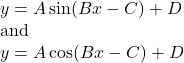
As we can see, sine and cosine functions have a regular period and range. If we watch ocean waves or ripples on a pond, we will see that they resemble the sine or cosine functions. However, they are not necessarily identical. Some are taller or longer than others. A function that has the same general shape as a sine or cosine function is known as a sinusoidal function. The general forms of sinusoidal functions are
Determining the Period of Sinusoidal Functions
Looking at the forms of sinusoidal functions, we can see that they are transformations of the sine and cosine functions. We can use what we know about transformations to determine the period.
In the general formula,  is related to the period by
  If
If  then the period is less than
  and the function undergoes a horizontal compression, whereas if
  then the period is greater than and the function undergoes a horizontal stretch. For example,
 so the period is which we knew. If
  then
then  so the period is and the graph is compressed. If
  then
then  so the period is
  and the graph is stretched. Notice in Figure 8 how the period is indirectly related to
Period of Sinusoidal Functions
If we let  and
and  in the general form equations of the sine and cosine functions, we obtain the forms


The period is 
Example 1
Identifying the Period of a Sine or Cosine Function
Determine the period of the function 
Solution
Let’s begin by comparing the equation to the general form 
In the given equation,  so the period will be

Try It 1
Determine the period of the function 
Determining Amplitude
Returning to the general formula for a sinusoidal function, we have analyzed how the variable relates to the period. Now let’s turn to the variable  so we can analyze how it is related to the amplitude, or greatest distance from rest. represents the vertical stretch factor, and its absolute value
  is the amplitude. The local maxima will be a distance above the horizontal midline of the graph, which is the line
  because in this case, the midline is the x-axis. The local minima will be the same distance below the midline. If
  the function is stretched. For example, the amplitude of
  is twice the amplitude of
  If
If  the function is compressed. Figure 9 compares several sine functions with different amplitudes.
Amplitude of Sinusoidal Functions
If we let and in the general form equations of the sine and cosine functions, we obtain the forms

The amplitude is  which is the vertical height from the midline
  In addition, notice in the example that

Example 2
Identifying the Amplitude of a Sine or Cosine Function
What is the amplitude of the sinusoidal function  Is the function stretched or compressed vertically?
Solution
Let’s begin by comparing the function to the simplified form
In the given function,  so the amplitude is
  The function is stretched.
Analysis
The negative value of results in a reflection across the x-axis of the sine function, as shown in Figure 10.
Try It 2
What is the amplitude of the sinusoidal function  Is the function stretched or compressed vertically?
Analyzing Graphs of Variations of y = sin x and y = cos x
Now that we understand how and relate to the general form equation for the sine and cosine functions, we will explore the variables  and
and  Recall the general form:

The value  for a sinusoidal function is called the phase shift, or the horizontal displacement of the basic sine or cosine function. If
  the graph shifts to the right. If
  the graph shifts to the left. The greater the value of
  the more the graph is shifted. Figure 11 shows that the graph of
  shifts to the right by units, which is more than we see in the graph of
  which shifts to the right by units.
While relates to the horizontal shift,  indicates the vertical shift from the midline in the general formula for a sinusoidal function. See Figure 12. The function
  has its midline at
Any value of other than zero shifts the graph up or down. Figure 13 compares  with
with  which is shifted 2 units up on a graph.
Variations of Sine and Cosine Functions
Given an equation in the form  or
or  is the phase shift and is the vertical shift.
Example 3
Identifying the Phase Shift of a Function
Determine the direction and magnitude of the phase shift for 
Solution
Let’s begin by comparing the equation to the general form 
In the given equation, notice that  and
and  So the phase shift is

or units to the left.
Analysis
We must pay attention to the sign in the equation for the general form of a sinusoidal function. The equation shows a minus sign before  Therefore
  can be rewritten as
  If the value of is negative, the shift is to the left.
Try It 3
Determine the direction and magnitude of the phase shift for 
Example 4
Identifying the Vertical Shift of a Function
Determine the direction and magnitude of the vertical shift for 
Solution
Let’s begin by comparing the equation to the general form 
In the given equation,  so the shift is 3 units downward.
Try It 4
Determine the direction and magnitude of the vertical shift for 
How To
Given a sinusoidal function in the form  identify the midline, amplitude, period, and phase shift.
- Determine the amplitude as

- Determine the period as
- Determine the phase shift as

- Determine the midline as
Example 5
Identifying the Variations of a Sinusoidal Function from an Equation
Determine the midline, amplitude, period, and phase shift of the function 
Solution
Let’s begin by comparing the equation to the general form
 so the amplitude is
Next, so the period is 
There is no added constant inside the parentheses, so and the phase shift is 
Finally,  so the midline is
Analysis
Inspecting the graph, we can determine that the period is the midline is  and the amplitude is 3. See Figure 14.
Try It 5
Determine the midline, amplitude, period, and phase shift of the function 
Example 6
Identifying the Equation for a Sinusoidal Function from a Graph
Determine the formula for the cosine function in Figure 15.
Solution
To determine the equation, we need to identify each value in the general form of a sinusoidal function.
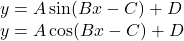
The graph could represent either a sine or a cosine function that is shifted and/or reflected. When  the graph has an extreme point,
  Since the cosine function has an extreme point for let us write our equation in terms of a cosine function.
Let’s start with the midline. We can see that the graph rises and falls an equal distance above and below  This value, which is the midline, is in the equation, so
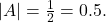
The greatest distance above and below the midline is the amplitude. The maxima are 0.5 units above the midline and the minima are 0.5 units below the midline. So  Another way we could have determined the amplitude is by recognizing that the difference between the height of local maxima and minima is 1, so
  Also, the graph is reflected about the x-axis so that
The graph is not horizontally stretched or compressed, so  and the graph is not shifted horizontally, so
Putting this all together,

Try It 6
Determine the formula for the sine function in Figure 16.
Example 7
Identifying the Equation for a Sinusoidal Function from a Graph
Determine the equation for the sinusoidal function in Figure 17.
Solution
With the highest value at 1 and the lowest value at  the midline will be halfway between at
  So
So 
The distance from the midline to the highest or lowest value gives an amplitude of
The period of the graph is 6, which can be measured from the peak at  to the next peak at
  or from the distance between the lowest points. Therefore,
  Using the positive value for
  we find that

So far, our equation is either  or
or  For the shape and shift, we have more than one option. We could write this as any one of the following:
- a cosine shifted to the right
- a negative cosine shifted to the left
- a sine shifted to the left
- a negative sine shifted to the right
Choosing to use the cosine function, we observe that the peak, which would normally be at  , is at , and given the horizontal compression factor of , we get
  .
.
While any of these would be correct, the cosine shifts are easier to work with than the sine shifts in this case because they involve integer values. So our function becomes

Again, these functions are equivalent, so both yield the same graph.
Try It 7
Write a formula for the function graphed in Figure 18.
Graphing Variations of y = sin x and y = cos x
Throughout this section, we have learned about types of variations of sine and cosine functions and used that information to write equations from graphs. Now we can use the same information to create graphs from equations.
Instead of focusing on the general form equations

we will let and and work with a simplified form of the equations in the following examples.
How To
Given the function  sketch its graph.
- Identify the amplitude,
- Identify the period,
- Start at the origin, with the function increasing to the right if is positive or decreasing if is negative.
- At
 there is a local maximum for
  or a minimum for
  with
with 
- The curve returns to the x-axis at

- There is a local minimum for (maximum for
 ) at
) at  with
with 
- The curve returns again to the x-axis at

Example 8
Graphing a Function and Identifying the Amplitude and Period
Sketch a graph of 
Solution
Let’s begin by comparing the equation to the form
- Step 1. We can see from the equation that
 so the amplitude is 2.
- Step 2. The equation shows that
 so the period is
- Step 3. Because is negative, the graph descends as we move to the right of the origin.
- Step 4–7. The x-intercepts are at the beginning of one period, the horizontal midpoints are at
 and at the end of one period at
The quarter points include the minimum at and the maximum at  A local minimum will occur 2 units below the midline, at
  and a local maximum will occur at 2 units above the midline, at Figure 19 shows the graph of the function.
Try It 8
Sketch a graph of  Determine the midline, amplitude, period, and phase shift.
How To
Given a sinusoidal function with a phase shift and a vertical shift, sketch its graph.
- Express the function in the general form

- Identify the amplitude,
- Identify the period,
- Identify the phase shift,
- Draw the graph of
 shifted to the right or left by and up or down by
Example 9
Graphing a Transformed Sinusoid
Sketch a graph of 
Solution
- Step 1. The function is already written in general form: This graph will have the shape of a sine function, starting at the midline and increasing to the right.
- Step 2.
 The amplitude is 3.
 - Step 3. Since
 we determine the period as follows.
 The period is 8.
 - Step 4. Since
 the phase shift is
 The phase shift is 1 unit.
 - Step 5. Figure 20 shows the graph of the function.
Figure 20 A horizontally compressed, vertically stretched, and horizontally shifted sinusoid
Try It 9
Draw a graph of  Determine the midline, amplitude, period, and phase shift.
Example 10
Identifying the Properties of a Sinusoidal Function
Given  determine the amplitude, period, phase shift, and vertical shift. Then graph the function.
Solution
Begin by comparing the equation to the general form and use the steps outlined in Example 9.

- Step 1. The function is already written in general form.
- Step 2. Since the amplitude is

- Step 3.
 so the period is
  The period is 4.
 - Step 4.
 so we calculate the phase shift as
  The phase shift is
 - Step 5.
 so the midline is
  and the vertical shift is up 3.
Since is negative, the graph of the cosine function has been reflected about the x-axis.
Figure 21 shows one cycle of the graph of the function.
Using Transformations of Sine and Cosine Functions
We can use the transformations of sine and cosine functions in numerous applications. As mentioned at the beginning of the chapter, circular motion can be modeled using either the sine or cosine function.
Example 11
Finding the Vertical Component of Circular Motion
A point rotates around a circle of radius 3 centered at the origin. Sketch a graph of the y-coordinate of the point as a function of the angle of rotation.
Solution
Recall that, for a point on a circle of radius r, the y-coordinate of the point is 
so in this case, we get the equation 
The constant 3 causes a vertical stretch of the y-values of the function by a factor of 3, which we can see in the graph in Figure 22.
Analysis
Notice that the period of the function is still  as we travel around the circle, we return to the point
  for
for  Because the outputs of the graph will now oscillate between
  and
and  the amplitude of the sine wave is
Try It 10
What is the amplitude of the function  Sketch a graph of this function.
Example 12
Finding the Vertical Component of Circular Motion
A circle with radius 3 ft is mounted with its center 4 ft off the ground. The point closest to the ground is labeled P, as shown in Figure 23. Sketch a graph of the height above the ground of the point  as the circle is rotated; then find a function that gives the height in terms of the angle of rotation.
Solution
Sketching the height, we note that it will start 1 ft above the ground, then increase up to 7 ft above the ground, and continue to oscillate 3 ft above and below the center value of 4 ft, as shown in Figure 24.
Although we could use a transformation of either the sine or cosine function, we start by looking for characteristics that would make one function easier to use than the other. Let’s use a cosine function because it starts at the highest or lowest value, while a sine function starts at the middle value. A standard cosine starts at the highest value, and this graph starts at the lowest value, so we need to incorporate a vertical reflection.
Second, we see that the graph oscillates 3 above and below the center, while a basic cosine has an amplitude of 1, so this graph has been vertically stretched by 3, as in the last example.
Finally, to move the center of the circle up to a height of 4, the graph has been vertically shifted up by 4. Putting these transformations together, we find that

Try It 11
A weight is attached to a spring that is then hung from a board, as shown in Figure 25. As the spring oscillates up and down, the position of the weight relative to the board ranges from  in. (at time
  to
to  in. (at time
  below the board. Assume the position of is given as a sinusoidal function of
  Sketch a graph of the function, and then find a cosine function that gives the position in terms of
Example 13
Determining a Rider’s Height on a Ferris Wheel
The London Eye is a huge Ferris wheel with a diameter of 135 meters (443 feet). It completes one rotation every 30 minutes. Riders board from a platform 2 meters above the ground. Express a rider’s height above ground as a function of time in minutes.
Solution
With a diameter of 135 m, the wheel has a radius of 67.5 m. The height will oscillate with amplitude 67.5 m above and below the center.
Passengers board 2 m above ground level, so the center of the wheel must be located  m above ground level. The midline of the oscillation will be at 69.5 m.
The wheel takes 30 minutes to complete 1 revolution, so the height will oscillate with a period of 30 minutes.
Lastly, because the rider boards at the lowest point, the height will start at the smallest value and increase, following the shape of a vertically reflected cosine curve.
- Amplitude:
 so
so 
- Midline:
 so
so 
- Period:
 so
so 
- Shape:

An equation for the rider’s height would be

where  is in minutes and is measured in meters.
Section 8.1 Exercises
- Why are the sine and cosine functions called periodic functions?
- How does the graph of
compare with the graph of
Explain how you could horizontally translate the graph of
to obtain
- For the equation
 what constants affect the range of the function and how do they affect the range?
 - How does the range of a translated sine function relate to the equation

- How can the unit circle be used to construct the graph of


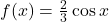















- Determine the amplitude, midline, period, and an equation involving the sine function for the graph shown in Figure 26.
Figure 26 - Determine the amplitude, period, midline, and an equation involving cosine for the graph shown in Figure 27.
Figure 27 - Determine the amplitude, period, midline, and an equation involving cosine for the graph shown in Figure 28.
Figure 28 - Determine the amplitude, period, midline, and an equation involving sine for the graph shown in Figure 29.
Figure 29 - Determine the amplitude, period, midline, and an equation involving cosine for the graph shown in Figure 30.
Figure 30 - Determine the amplitude, period, midline, and an equation involving sine for the graph shown in Figure 31.
Figure 31 - Determine the amplitude, period, midline, and an equation involving cosine for the graph shown in Figure 32.
Figure 32 - Determine the amplitude, period, midline, and an equation involving sine for the graph shown in Figure 33.
Figure 33 - On
 solve
solve 
- On solve

- Evaluate

- On
 Find all values of
 - On the maximum value(s) of the function occur(s) at what x-value(s)?
- On the minimum value(s) of the function occur(s) at what x-value(s)?
- Show that
 This means that
  is an odd function and possesses symmetry with respect to ________________.
 - On solve the equation

- On solve
- On find the x-intercepts of

- On find the x-values at which the function has a maximum or minimum value.
- On solve the equation

- Graph
 on
on ![[0,2\pi].](https://foundations-of-math12.pressbooks.tru.ca/wp-content/ql-cache/quicklatex.com-ce6a45ad4b148e7a7328555012e216eb_l3.png "Rendered by QuickLaTeX.com") Explain why the graph appears as it does.
Explain why the graph appears as it does. - Graph on
![[-100,100].](https://foundations-of-math12.pressbooks.tru.ca/wp-content/ql-cache/quicklatex.com-7fee2e0e1029ae5df63e819eb61d0604_l3.png "Rendered by QuickLaTeX.com") Did the graph appear as predicted in the previous exercise?
Did the graph appear as predicted in the previous exercise? - Graph
 on
on ![[0,2\pi]](https://foundations-of-math12.pressbooks.tru.ca/wp-content/ql-cache/quicklatex.com-3ec5c33268354f40a93efd2f14d8fc04_l3.png "Rendered by QuickLaTeX.com") and verbalize how the graph varies from the graph of
and verbalize how the graph varies from the graph of 
- Graph on the window
![[-10,10]](https://foundations-of-math12.pressbooks.tru.ca/wp-content/ql-cache/quicklatex.com-0dd8fe654e2bf92a5d7efc5a8532c197_l3.png "Rendered by QuickLaTeX.com") and explain what the graph shows.
and explain what the graph shows. - Graph
 on the window
 ![[-5\pi,5\pi]](https://foundations-of-math12.pressbooks.tru.ca/wp-content/ql-cache/quicklatex.com-bb2c3355e19b01ba0e5c7b399a0c6900_l3.png "Rendered by QuickLaTeX.com") and explain what the graph shows.
and explain what the graph shows. - A Ferris wheel is 25 meters in diameter and boarded from a platform that is 1 meter above the ground. The six o’clock position on the Ferris wheel is level with the loading platform. The wheel completes 1 full revolution in 10 minutes. The function
 gives a person’s height in meters above the ground t minutes after the wheel begins to turn.
- Find the amplitude, midline, and period of

- Find a formula for the height function
- How high off the ground is a person after 5 minutes?
- Find the amplitude, midline, and period of
Section 8.1 Exercises Answers
1. The sine and cosine functions have the property that for a certain . This means that the function values repeat for every units on the x-axis.
3. The absolute value of the constant (amplitude) increases the total range and the constant (vertical shift) shifts the graph vertically.
5. At the point where the terminal side of intersects the unit circle, you can determine that the  equals the y-coordinate of the point.
7.
amplitude:  ; period: ; midline:
  ; maximum:
  occurs at ; minimum:
  occurs at
  ; for one period, the graph starts at 0 and ends at
9.
amplitude: 4; period: ; midline: ; maximum  occurs at
  ; minimum:
  occurs at
  ; one full period occurs from to
11.
amplitude: 1; period: ; midline: ; maximum:  occurs at ; minimum:
  occurs at ; one full period is graphed from to
13.
amplitude: 4; period: 2; midline: ; maximum: occurs at ; minimum: occurs at
15.
amplitude: 3; period: ; midline:  ; maximum:
  occurs at
  ; minimum:
  occurs at
  ; horizontal shift:
  ; vertical translation 5; one period occurs from to
17.
amplitude: 5; period:  ; midline:
  ; maximum:
  occurs at
  ; minimum:
  occurs at
  ; phase shift: ; vertical translation:
  ; one full period can be graphed on to
19.
amplitude: 1 ; period: ; midline: ; maximum: occurs at  ; maximum: occurs at
  ; minimum: occurs at
  ; phase shift:
  ; vertical translation: 1; one full period is from
  to
to 
21.
amplitude: 1; period: ; midline: ; maximum: occurs at  ; minimum: occurs at ; phase shift:
  ; vertical shift: 0
23. amplitude: 2; midline:  ; period: 4; equation:
25. amplitude: 2; period: 5; midline: ; equation: 
27. amplitude: 4; period: 2; midline: ; equation: 
29. amplitude: 2; period: 2; midline ; equation: 
31. 
33. 
35.
37. is symmetric
39. 
41. Maximum: 1 at ; minimum: -1 at
43. A linear function is added to a periodic sine function. The graph does not have an amplitude because as the linear function increases without bound the combined function will increase without bound as well. The graph is bounded between the graphs of  and
and  because sine oscillates between −1 and 1.
45. There is no amplitude because the function is not bounded.
47. The graph is symmetric with respect to the y-axis and there is no amplitude because the function’s bounds decrease as  grows. There appears to be a horizontal asymptote at .
Text Attribution
This text was adapted from Chapter 8.1 of Algebra and Trigonometry 2e, textbooks originally published by OpenStax.