
Ch. 6 Practice Test – Algebra and Trigonometry 2e | OpenStax
Practice Test
- The population of a pod of bottlenose dolphins is modeled by the function
 where
where  is given in years. To the nearest whole number, what will the pod population be after
  years?
 - Find an exponential equation that passes through the points
 and
and  .
. - Drew wants to save $2,500 to go to the next World Cup. To the nearest dollar, how much will he need to invest in an account now with
 APR, compounding daily, in order to reach his goal in
  years?
 - An investment account was opened with an initial deposit of $9,600 and earns
 interest, compounded continuously. How much will the account be worth after
  years?
 - Graph the function
 and its reflection across the y-axis on the same axes, and give the y-intercept.
 - The graph shows transformations of the graph of
 What is the equation for the transformation?
Figure [Number] [caption text]
- Rewrite
 as an equivalent exponential equation.
 - Rewrite
 as an equivalent logarithmic equation.
 - Solve for
 by converting the logarithmic equation
  to exponential form.
 - Evaluate
 without using a calculator.
 - Evaluate
 using a calculator. Round to the nearest thousandth.
 - Graph the function

- State the domain, vertical asymptote, and end behavior of the function

- Rewrite
 as a sum.
 - Rewrite
 in compact form.
 - Rewrite
 as a product.
 - Use properties of logarithm to expand
![\mathrm{ln}\left({y}^{3}{z}^{2}\cdot \sqrt[3]{x-4}\right).](https://foundations-of-math12.pressbooks.tru.ca/wp-content/ql-cache/quicklatex.com-f545a83abf9dcec40413ac1cf59856c1_l3.png "Rendered by QuickLaTeX.com")
- Condense the expression
 to a single logarithm.
 - Rewrite
 as a logarithm. Then apply the change of base formula to solve for using the natural log. Round to the nearest thousandth.
 - Solve
 by rewriting each side with a common base.
 - Use logarithms to find the exact solution for
 . If there is no solution, write no solution.
 - Find the exact solution for
 If there is no solution, write no solution.
 - Find the exact solution for
 If there is no solution, write no solution.
 - Find the exact solution for
 If there is no solution, write no solution.
 - Find the exact solution for
 If there is no solution, write no solution.
 - Use the definition of a logarithm to find the exact solution for

- Use the one-to-one property of logarithms to find an exact solution for
 If there is no solution, write no solution.
 - The formula for measuring sound intensity in decibels
 is defined by the equation
 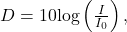 where
where  is the intensity of the sound in watts per square meter and
  is the lowest level of sound that the average person can hear. How many decibels are emitted from a rock concert with a sound intensity of
  watts per square meter?
 - A radiation safety officer is working with
 grams of a radioactive substance. After
  days, the sample has decayed to
  grams. Rounding to five significant digits, write an exponential equation representing this situation. To the nearest day, what is the half-life of this substance?
 - Write the formula found in the previous exercise as an equivalent equation with base
 Express the exponent to five significant digits.
 - A bottle of soda with a temperature of
 Fahrenheit was taken off a shelf and placed in a refrigerator with an internal temperature of
  After ten minutes, the internal temperature of the soda was
  Use Newton’s Law of Cooling to write a formula that models this situation. To the nearest degree, what will the temperature of the soda be after one hour?
 - The population of a wildlife habitat is modeled by the equation
 where is given in years. How many animals were originally transported to the habitat? How many years will it take before the habitat reaches half its capacity?
 - Enter the data from Table 1 into a graphing calculator and graph the resulting scatter plot. Determine whether the data from the table would likely represent a function that is linear, exponential, or logarithmic.
Table 1 x f(x) 1 3 2 8.55 3 11.79 4 14.09 5 15.88 6 17.33 7 18.57 8 19.64 9 20.58 10 21.42 - The population of a lake of fish is modeled by the logistic equation
 where is time in years. To the nearest hundredth, how many years will it take the lake to reach
  of its carrying capacity?
For the following exercises, use a graphing utility to create a scatter diagram of the data given in the table. Observe the shape of the scatter diagram to determine whether the data is best described by an exponential, logarithmic, or logistic model. Then use the appropriate regression feature to find an equation that models the data. When necessary, round values to five decimal places.
-
x f(x) 1 20 2 21.6 3 29.2 4 36.4 5 46.6 6 55.7 7 72.6 8 87.1 9 107.2 10 138.1 -
x f(x) 3 13.98 4 17.84 5 20.01 6 22.7 7 24.1 8 26.15 9 27.37 10 28.38 11 29.97 12 31.07 13 31.43 -
x f(x) 0 2.2 0.5 2.9 1 3.9 1.5 4.8 2 6.4 3 9.3 4 12.3 5 15 6 16.2 7 17.3 8 17.9